
- AODA Training Requirements for Employers in Ontario
- AODA Training
AODA Training Requirements for Employers in Ontario (2026)
Ontario law is specific about what employers must do when it comes to AODA training. This page sets out who must be trained, what that training must cover, when it must happen, and — for larger organizations — what records must be kept.
Quantity Discounts
Price per course
6 to 20 courses
$20.95
21 to 50 courses
$17.95
51 to 200 courses
$13.95
201+ courses
Custom offer
Ontario law is specific about what employers must do when it comes to AODA training. It is not enough to run a training session once and move on. The Act sets out who must be trained, what that training must cover, when it must happen, and — for larger organizations — what records must be kept.
This page covers all of that. If you are an employer in Ontario trying to understand exactly what the law requires, this is your reference.
The legal basis for AODA training requirements
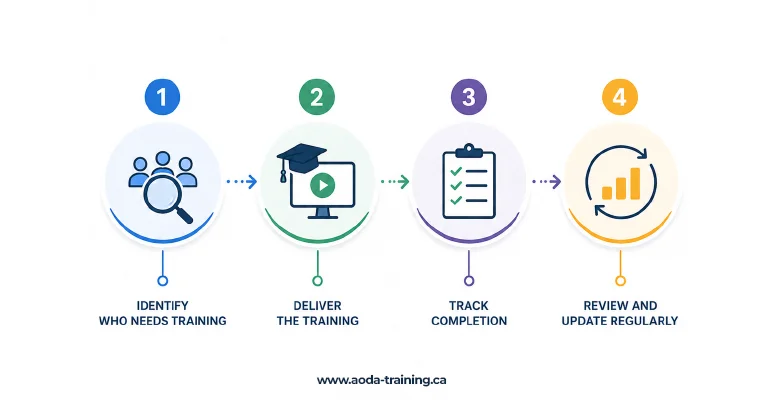
AODA training obligations come from two sources within the Act:
1. The Customer Service Standard
Ontario Regulation 429/07 requires every organization with at least one employee to train all staff on accessible customer service. This has been in force for private-sector businesses since January 1, 2012. There is no organization in Ontario with employees that is exempt from this requirement.
2. The Integrated Accessibility Standards Regulation (IASR)
Ontario Regulation 191/11 extends training requirements further. Under the IASR, organizations must also train staff on the contents of the regulation itself and on the Ontario Human Rights Code as it relates to persons with disabilities. The IASR applies to all organizations in Ontario with at least one employee, though the scope of obligations depends on size.
Most employers focus only on the Customer Service Standard. But the IASR training requirement is equally mandatory. Organizations that have only delivered Customer Service training — without IASR training on the Human Rights Code — are partially out of compliance.
Who you are required to train
Both the Customer Service Standard and the IASR apply the training requirement broadly. You must train:
- All employees — full-time, part-time, seasonal, casual, and fixed-term
- Volunteers who interact with the public or are involved in policy development
- Third-party contractors who deliver services to your customers on your behalf
- Anyone who develops, implements, or enforces your organization's accessibility policies
What AODA training must cover
Customer Service Standard training content
Under the Customer Service Standard, training must cover:
- The purposes of AODA and the requirements of the Customer Service Standard
- How to interact and communicate with people with various types of disability
- How to interact with people who use an assistive device, guide dog, service animal, or support person
- How to use equipment or devices available at your premises to assist people with disabilities
- What to do if a person with a disability is having difficulty accessing your goods, services, or facilities
- Your organization's specific policies, practices, and procedures relating to the Customer Service Standard
Customer Service Standard training content
Under the IASR, training must cover:
- The requirements of the IASR that apply to your organization
- The Ontario Human Rights Code as it pertains to persons with disabilities
Customer Service Standard training + IASR training (including Human Rights Code content)
All of the above + Employment Standard training (Individual Accommodation Plans, accessible recruitment, return-to-work)
All of the above + Information & Communications training (WCAG 2.0 Level AA, accessible documents, accessible formats)
When AODA training must be delivered
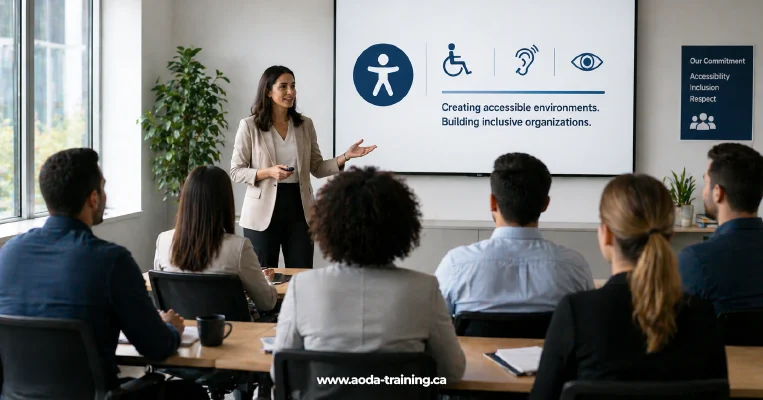
Timing is one of the most commonly misunderstood aspects of AODA training compliance. The standard is “as soon as practicable” — which regulators consistently interpret to mean before the person begins performing their role, or on their first day at the latest.
| Trigger | When training must be delivered |
|---|---|
| Existing employees (all sizes) | Already required. If not yet completed, you are currently non-compliant. |
| New employee hired | Before they begin, or as soon as reasonably practicable after starting. No formal grace period exists in the legislation. |
| Volunteer starts | Same as new employees. Must be trained before or shortly after they begin. |
| Contractor engaged | Before they begin delivering services on your behalf. |
| Accessibility policy changes | Training must be updated to reflect the change and re-delivered to all affected staff. |
| Staff member changes roles | If their new role has different accessibility responsibilities, role-specific training must be updated. |
| AODA regulations updated | Training must be updated to reflect regulatory changes. |
Training obligations by organization size
| Requirement | 1–19 employees | 20–49 employees | 50+ employees |
|---|---|---|---|
| Customer Service Standard training | ✓ Required | ✓ Required | ✓ Required |
| IASR training (inc. Human Rights Code) | ✓ Required | ✓ Required | ✓ Required |
| Training records | Recommended | Recommended | ✓ Required by law |
| Written accessibility policy | Recommended | Recommended | ✓ Required — publicly available |
| Multi-year accessibility plan | Not required | Not required | ✓ Required — posted publicly |
| AODA compliance report filing | Not required | ✓ Every 3 years | ✓ Every 3 years |
| Individual Accommodation Plan process | If applicable | If applicable | ✓ Documented process required |
What counts as compliant AODA training?
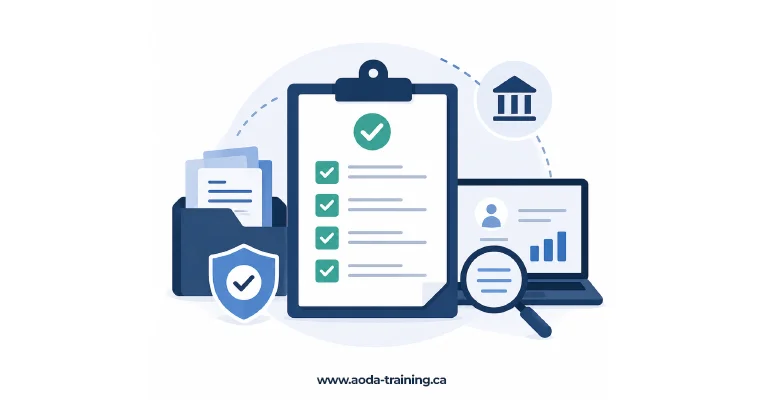
AODA does not prescribe a specific training format, duration, or delivery method. It sets out what training must cover, not how it must be delivered. Acceptable formats include:
- Online courses — the most common choice; must cover required content and ideally generate completion certificates
- In-person workshops or group sessions
- Written training materials combined with a signed acknowledgement
- Video-based training with a knowledge check
- Blended learning — a combination of online and in-person elements
- › A training session run once when AODA first came into force, with no refreshers since
- › Generic accessibility awareness training that does not reference the Customer Service Standard or IASR
- › Training that covers the Standard but does not include your organization's specific policies
- › Training completed by some staff but not others — partial completion is non-compliance
- › A policy document handed to staff to read, with no verification that they read or understood it
- › Training records that show a date but do not identify what was covered
Keeping AODA training records
For organizations with 50 or more employees, maintaining training records is a legal requirement. At minimum, your training records should show:
- The employee's name and role
- The date training was completed
- What the training covered (Customer Service Standard, IASR, role-specific modules)
- The delivery method (online course name, in-person session, etc.)
- A completion certificate or signed acknowledgement
Consequences of not meeting AODA training requirements
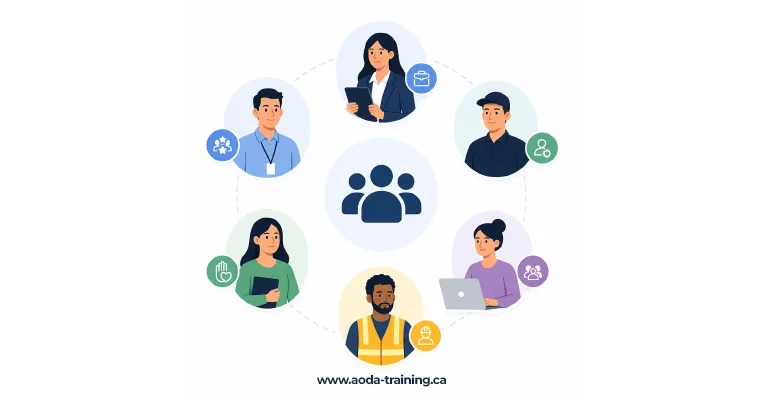
The Ontario government enforces AODA through the Accessibility Directorate of Ontario. Enforcement happens through audits (both random and complaint-triggered), compliance orders, and fines.
$100,000/day
Maximum fine for non-compliant organizations
$50,000/day
Personal liability for directors and officers
Frequently asked questions
Is AODA training a legal requirement for all Ontario employers?
- Yes. Every Ontario organization with at least one employee must train its staff on the Customer Service Standard and the IASR. There is no size threshold, industry exemption, or revenue minimum. The obligation applies from the moment you hire your first employee.
What happens if a new employee is not trained on AODA before they start?
- Technically, training should happen before or on the day they start. If a new employee interacts with a customer before completing AODA training and there is a complaint, your organization is exposed. The law uses the phrase “as soon as practicable” — the expectation is that training is part of your onboarding, not something scheduled weeks later.
Can I use a free online AODA training course to meet my obligations?
- Possibly, but not automatically. The Ontario government’s free AccessForward training covers the Customer Service Standard requirements for most employees. However, free courses typically do not include your organization’s specific accessibility policies — which is a required element of the training. If you use a free course, you need to supplement it with a policy briefing specific to your organization.
Do I need to retrain staff every year?
- No, not on an annual cycle. The law requires retraining when your accessibility policies change, when staff move into roles with different obligations, or when the government updates accessibility regulations. Annual review of your training content is best practice — but mandatory retraining is triggered by changes, not by the calendar.
Does AODA training apply to remote workers?
- Yes. Remote employees are employees. Their physical location does not change the fact that they work for an Ontario organization and are covered by AODA. Online training makes this straightforward — remote staff can complete their training through the same platform as on-site staff.
Empower Your Team with Digital Accessibility
Ensure compliance, reduce legal risks, and build inclusive digital experiences.
Start AODA training for your team →Make sure your organization meets the requirements
If you are not confident that every current employee, volunteer, and contractor has completed compliant AODA training — and that new hires are trained as part of onboarding — that is where to start.
- Customer Service Standard training — mandatory for all staff
- Role-specific modules for managers, HR, IT, and content teams
- Completion certificates and audit-ready records for every staff member
- IASR training including Ontario Human Rights Code content
- Custom policy content so training reflects your specific policies
- Onboarding-compatible format — assign training to new hires on day one