
- AODA Employment Standard: Employer Obligations Explained
- AODA Training
AODA Employment Standard: Employer Obligations Explained
The AODA Employment Standard governs how organizations recruit, hire, onboard, and support employees with disabilities. It applies to every Ontario employer with at least one employee and has been in force since 2014. For HR and managers, this is where AODA and the Ontario Human Rights Code intersect most directly.
Quantity Discounts
Price per course
6 to 20 courses
$20.95
21 to 50 courses
$17.95
51 to 200 courses
$13.95
201+ courses
Custom offer
The AODA Employment Standard is the part of Ontario’s accessibility law that governs how organizations recruit, hire, onboard, and support employees with disabilities. It applies to every Ontario employer with at least one employee and has been in force since 2014.
For HR professionals and managers, this Standard is where AODA and the Ontario Human Rights Code intersect most directly. Understanding what it requires — and training your team on it — is not just a compliance exercise. It is what makes your organization a place where employees with disabilities can actually work.
What is the AODA Employment Standard?
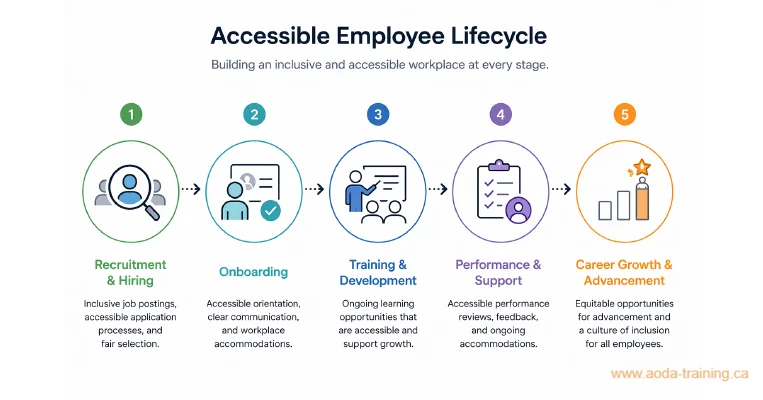
The Employment Standard is Part II of the Integrated Accessibility Standards Regulation (IASR), Ontario Regulation 191/11. It covers employment-related accessibility obligations across the full employment lifecycle — from recruiting a candidate to supporting them when they leave.
It applies to all Ontario employers with at least one employee. However, certain obligations — specifically the formal Individual Accommodation Plan process and the return-to-work process — apply only to organizations with 50 or more employees. All other obligations apply regardless of size.
The Employment Standard sets out specific proactive steps employers must take. The Ontario Human Rights Code prohibits discrimination on the basis of disability and requires accommodation to the point of undue hardship. They overlap significantly. An employer who follows the Employment Standard conscientiously is also likely meeting most of their Human Rights Code obligations in the disability context — but compliance with AODA does not automatically guarantee compliance with the Code.
The seven key obligations under the Employment Standard
The Employment Standard creates seven specific obligations for Ontario employers. Here is what each one requires.
-
1
Notify employees and the public of accessibility support availability
Employers must notify employees and the public that accommodation is available during the recruitment process and throughout employment. This typically means including a statement in job postings and on your careers page, and verbally confirming it at interview stages.
-
2
Accessible recruitment: notify applicants of accommodation availability
When inviting candidates to a job interview or to participate in a selection process, employers must notify them that accommodation is available upon request. If a candidate requests accommodation, the employer must consult with them and provide it in a format that meets their needs.
-
3
Notify successful applicants of accommodation policies
When making a job offer to a successful applicant, the employer must notify them of their accommodation policies. This ensures the new employee knows support is available before they start.
-
4
Inform employees of accommodation support
Employers must inform all employees of their policies for supporting employees with disabilities, including policies on providing job accommodation. This information must be provided to new employees as soon as practicable after starting, and to existing employees when policies change.
-
5
Accessible formats and communication supports
When an employee with a disability requests it, the employer must provide or arrange for accessible formats of information needed to perform their job, and communication supports. This includes employment information such as offer letters, training materials, performance reviews, and workplace safety procedures.
-
6
Individual Accommodation Plans (IAPs) — 50+ employees
Organizations with 50 or more employees must have a written process for developing IAPs with employees who have disabilities. The process must include how the employee can participate, how outside experts can be consulted if needed, how privacy of information will be maintained, how often the plan will be reviewed, and how it can be disputed.
-
7
Return-to-work process — 50+ employees
Organizations with 50 or more employees must have a documented return-to-work process for employees who are absent due to disability and need disability-related accommodations to return. The process must outline the steps the employer will take to facilitate the return, consistent with the organization's duty to accommodate under the Human Rights Code.
Accessible recruitment: what it means in practice
Accessible recruitment is one of the most visible parts of the Employment Standard and one where employers have clear, specific obligations at each stage of the hiring process.
| Stage | Obligation | Practical example |
|---|---|---|
| Job posting | State that accommodation is available for applicants with disabilities during the recruitment process | Add a line to every job posting: "We are committed to providing accommodation for applicants with disabilities. Please contact [HR contact] to request accommodation." |
| Interview invitation | Notify candidates that accommodation is available and provide it when requested | Include in your interview invitation email: "If you require accommodation for this interview, please let us know by [date]." |
| Selection process | Provide accommodation that meets the candidate's needs, in consultation with them | A candidate who is Deaf requests a sign language interpreter. The employer arranges one for the interview. |
| Job offer | Notify the successful candidate of the organization's accommodation policies | Include in the offer letter: "Our organization has policies to support employees with disabilities. Copies are available on request." |
| Onboarding | Inform the new employee of accommodation support and provide information in accessible formats if needed | Provide onboarding materials in accessible formats upon request before or on the first day. |
Individual Accommodation Plans: a step-by-step guide

For organizations with 50 or more employees, the Individual Accommodation Plan (IAP) is the Employment Standard’s most substantive requirement. An IAP is a written document that captures the specific accommodations an employee with a disability needs to perform their role and participate fully in the workplace.
- › A way for the employee to participate in the creation of their own plan
- › A method for assessing whether an expert needs to be involved (e.g. occupational therapist, medical professional)
- › Measures to protect the privacy of the employee's personal information
- › A frequency for reviewing and updating the plan
- › A process for addressing disagreements about the plan's contents
- › Provision for the employee to request a support person at any meeting about the plan
- › A format for the plan that is accessible to the employee
Plans must be reviewed when the employee’s situation changes, when the employee returns from a disability-related absence, or at minimum on the schedule set out in the plan.
Not a medical record. Employers should not request or store detailed medical information as part of the IAP process. The plan documents what accommodation is needed, not why. Medical documentation may be relevant to establishing that an accommodation is needed, but it belongs in a separate, confidential file.
Not a performance improvement plan. It should not be framed as a response to underperformance — it is a proactive support tool. Conflating accommodation with performance management is a common error that can create Human Rights Code liability.
Return-to-work: what employers are required to do
The return-to-work process applies when an employee returns from a leave of absence due to a disability and needs accommodation to perform their role. For organizations with 50 or more employees, this process must be documented.
What the process must address
- The steps the employer will take to facilitate the employee's return to work
- The use of Individual Accommodation Plans in the return-to-work context
- How the employee's role and responsibilities may be modified on a temporary or permanent basis
- How assistive technology or other supports will be arranged
- How the process will be reviewed and updated as the employee's circumstances change
How it connects to the Human Rights Code
The return-to-work process under AODA sits alongside — but does not replace — the duty to accommodate under the Ontario Human Rights Code. The Code’s duty to accommodate requires employers to make adjustments to the point of undue hardship, which may go further than the AODA’s documented process. Managers handling return-to-work situations should understand both frameworks and know when to involve HR or legal counsel.
- › Requiring the employee to return to their exact previous role without assessing accommodation needs
- › Demanding a "full medical clearance" before allowing any return, even to modified duties
- › Using a return-to-work conversation as an opportunity to discuss performance concerns
- › Not updating the Individual Accommodation Plan when the employee's needs change during reintegration
- › Treating the return-to-work process as complete once the employee is back at their desk
Performance management and career development
The Employment Standard explicitly requires that performance management, career development, and redeployment processes account for the accessibility needs of employees with disabilities.
Performance management
When conducting performance reviews, managers must ensure the process itself is accessible — documents in accessible formats if needed, communication supports if requested, and adequate time for the employee to respond. Performance standards should be assessed against what the employee can achieve with appropriate accommodation, not against an inaccessible baseline.
Career development and advancement
Employees with disabilities must have the same access to career development opportunities as other employees. If training, mentorship programs, or promotion opportunities are not accessible, the employer must provide accommodation so the employee can participate. Excluding an employee from career development because accommodation seems inconvenient is both an AODA compliance failure and potential Human Rights Code discrimination.
Redeployment
If an employee with a disability can no longer perform their original role — even with accommodation — the employer must consider whether redeployment to another suitable role is possible before concluding that undue hardship prevents continued employment. This is an area where legal advice is often appropriate.
| Question | Why it matters |
|---|---|
| Does the course include content about our specific accessibility policies, or can we add them? | Required under the Customer Service Standard. If not included, you need to supplement training separately. |
| Does the course cover the IASR, including the Ontario Human Rights Code? | Mandatory for all Ontario employers. Many generic 'AODA awareness' courses skip this. |
| Are there role-specific modules for managers, HR, and digital teams? | Different roles have different legal obligations. Generic training may not satisfy all of them. |
| What records does the platform generate, and in what format? | You need records that show who was trained, when, and what the training covered. Check the export format. |
| Can we assign training to new hires automatically as part of onboarding? | Training should happen on or before day one. A platform that integrates with onboarding makes this reliable. |
| How is the course updated when regulations change? | AODA standards continue to evolve. Your training content needs to reflect current requirements. |
Employment Standard obligations by organization size

| Obligation | 1–49 employees | 50+ employees |
|---|---|---|
| Notify public of accommodation availability | ✓ Required | ✓ Required |
| Notify applicants of accommodation at recruitment | ✓ Required | ✓ Required |
| Notify successful candidates of accommodation policy | ✓ Required | ✓ Required |
| Inform employees of accommodation support | ✓ Required | ✓ Required |
| Provide accessible formats & communication supports | ✓ Required | ✓ Required |
| Documented IAP process | Not required | ✓ Required |
| Documented return-to-work process | Not required | ✓ Required |
| Duty to accommodate (Human Rights Code) | ✓ Applies | ✓ Applies |
Frequently asked questions
Does the Employment Standard apply to organizations with fewer than 50 employees?
- Yes, most of it does. The two obligations that are specific to organizations with 50 or more employees are the formal Individual Accommodation Plan process and the documented return-to-work process. All other Employment Standard obligations — accessible recruitment, notifying applicants of accommodation, informing employees of support policies, and providing accessible formats — apply to all Ontario employers with at least one employee.
When does an employer need to create an Individual Accommodation Plan?
- An IAP is created when an employee with a disability requests accommodation, or when it becomes evident that an accommodation is needed. You do not need to proactively create IAPs for all employees with disabilities — but you must have a documented process ready and must respond promptly when accommodation is needed. Delaying or refusing to engage with an accommodation request is a compliance failure under both AODA and the Human Rights Code.
Can an employer ask for medical documentation to support an accommodation request?
- Yes, within limits. An employer can request sufficient information to establish that an accommodation is needed and to determine what form it should take. An employer cannot request a full diagnosis or detailed medical history. The standard is that the employer needs enough information to make an informed accommodation decision — not a complete medical picture. Medical information received must be kept strictly confidential and stored separately from other employment records.
What is undue hardship and when does it apply?
- Undue hardship is the threshold beyond which an employer is not required to accommodate under the Ontario Human Rights Code. It is a high bar — cost, inconvenience, or disruption alone is generally not sufficient. To claim undue hardship, an employer must demonstrate that accommodation would fundamentally alter the nature of the business or impose a cost that cannot be managed. This determination typically requires evidence and is subject to challenge at the Human Rights Tribunal of Ontario.
Does the Employment Standard cover mental health conditions?
- Yes. Disability under both AODA and the Ontario Human Rights Code includes mental health conditions such as depression, anxiety disorders, PTSD, and others. The accommodation obligations — including IAPs, accessible formats, and return-to-work processes — apply to mental health disabilities in the same way they apply to physical disabilities. Managers should be trained to recognize and respond to accommodation needs related to mental health without stigma or assumptions about the employee’s capability.
Is Employment Standard training required for all staff or just managers?
- The IASR requires that all employees be trained on the IASR requirements that apply to their role and on the Ontario Human Rights Code as it relates to disability. For frontline staff, this typically means a general overview. For managers and HR professionals who directly handle accommodation, recruitment, and performance management, more detailed training on the Employment Standard is required.
Empower Your Team with Digital Accessibility
Ensure compliance, reduce legal risks, and build inclusive digital experiences.
Start AODA training for your team →Train your managers and HR team on the Employment Standard
Employment Standard obligations sit primarily with managers and HR professionals. Getting this training right protects your organization from both AODA enforcement and Human Rights Tribunal complaints, and it creates a workplace that employees with disabilities can actually thrive in.
- All seven Employment Standard obligations under the IASR
- The IAP process: how to develop, maintain, and review accommodation plans
- Performance management, career development, and redeployment with accommodation
- Accessible recruitment: postings, interviews, offers, and onboarding
- Return-to-work: the documented process and common pitfalls to avoid
- The Ontario Human Rights Code: duty to accommodate, undue hardship, and discrimination