
- AODA Training for Managers
- AODA Training
AODA Training for Managers: What Supervisors Need to Know
Managers have specific AODA obligations beyond general staff training. Learn what supervisors must understand about accommodation, IAPs, accessible recruitment, and more.
Quantity Discounts
Price per course
6 to 20 courses
$20.95
21 to 50 courses
$17.95
51 to 200 courses
$13.95
201+ courses
Custom offer
Every Ontario employee needs AODA training. But managers need more than the standard course. They carry specific obligations under the AODA’s Employment Standard that frontline staff do not — obligations that come into play in hiring decisions, accommodation conversations, performance reviews, and return-to-work situations.
Getting these wrong does not just create an AODA compliance problem. It creates Ontario Human Rights Code liability, personal exposure for the manager, and real harm to the employee. This page explains what AODA training for managers must cover, how it differs from general staff training, and what good management practice looks like in each area.
Why Manager Training Goes Beyond General AODA Training

General AODA training covers the Customer Service Standard — the four principles of accessible service, how to interact with customers who have disabilities, and what to do in a service disruption. All staff need this.
Managers need all of that, plus training on the Employment Standard under the IASR. The Employment Standard creates obligations that play out in employment decisions — not customer interactions. It is the part of AODA that governs how organizations recruit, onboard, accommodate, and support employees with disabilities.
What AODA Manager Training Must Cover
The IASR requires that staff be trained on the IASR requirements that apply to their role. For managers, that means the Employment Standard — in full. Here is what that training must address.
| Employment Standard topic | Why managers need to understand it |
|---|---|
| Accessible recruitment | Managers who conduct interviews must know that accommodation for candidates with disabilities is mandatory, not discretionary. Denial or delay of candidate accommodation creates liability under both AODA and the Human Rights Code. |
| Notifying successful applicants of accommodation policies | The job offer is a legally significant moment. Managers who make verbal offers must include the accommodation policy statement, not leave it to HR to add later. |
| Informing employees of accommodation support | When a new employee starts, the manager's onboarding conversation must include information about how to request accommodation. This is not an HR-only responsibility. |
| Individual Accommodation Plans (IAPs) | Managers at organizations with 50+ employees must understand the IAP process — how to initiate it, how to participate in developing a plan, what they can and cannot ask for, and how to review and update plans over time. |
| Return-to-work processes | When an employee returns from a disability-related absence, the manager leads the reintegration. They must know the documented process, how to modify duties appropriately, and when to escalate to HR or legal counsel. |
| Performance management with accommodation | A manager who assesses an employee's performance against inaccessible standards, or who uses performance management as a proxy for accommodation pressure, is creating Human Rights Code liability. Managers must know how to conduct accessible performance reviews. |
| Career development and advancement | Managers who control access to training, mentoring, or promotion opportunities must ensure these are available to employees with disabilities on equal terms. Excluding someone from a career development opportunity because of a disability is discrimination. |
| The Ontario Human Rights Code | The IASR explicitly requires that training cover the Human Rights Code as it pertains to disability. Managers need to understand the duty to accommodate, undue hardship, and what constitutes disability-related discrimination and harassment. |
Manager Scenarios: What to Do and What Not to Do

Understanding the legal framework is necessary. Knowing how to apply it in real workplace situations is what distinguishes trained managers from untrained ones. These scenarios cover the most common situations managers face.
The Individual Accommodation Plan: A Manager's Guide
At organizations with 50 or more employees, the Individual Accommodation Plan (IAP) is the Employment Standard’s most substantive requirement. Managers are central to the process — they initiate it, participate in developing the plan, and are responsible for implementing it day to day.
- ✓ What the employee needs in order to perform their role
- ✓ What specific adjustments would help — modified hours, assistive technology, different workspace, accessible document formats
- ✓ Whether an external expert (occupational therapist, ergonomics specialist) would help inform the plan
- ✓ How often the plan should be reviewed
- ✗ The name or nature of the employee's medical condition or diagnosis
- ✗ Why the employee has the disability or how long it is expected to last
- ✗ Whether the disability is "real" or medically documented (medical information is handled through HR)
- ✗ Whether the employee could "get better" with different treatment or lifestyle choices
Reviewing and updating IAPs
IAPs are not permanent documents. They must be reviewed whenever the employee’s circumstances change, when the employee returns from a disability-related absence, and at the intervals set out in the plan itself. A manager who created an IAP two years ago and has never revisited it is not meeting their ongoing obligation. Schedule IAP reviews as a recurring calendar item.
Accommodation and Performance Management: Getting the Balance Right
One of the areas where managers most frequently create legal exposure is at the intersection of accommodation and performance management. The two must be kept conceptually separate — but they interact in practice in ways that are easy to mishandle.
Performance standards must account for accommodation
An employee with a disability who has an IAP in place should be assessed against what they can achieve with appropriate accommodation — not against an inaccessible baseline. If an employee’s accommodation includes modified hours and a manager’s performance review penalizes them for ‘lack of availability,’ that is a Human Rights Code violation.
Accommodation is not a performance reward
Accommodation is a legal right, not a benefit that managers grant at their discretion. An employee who is meeting performance expectations does not need to ‘earn’ accommodation. An employee whose performance is below expectations is still entitled to accommodation if their disability is a factor — and the appropriate response is to assess whether the performance gap is itself a function of inadequate accommodation.
When performance concerns arise alongside a disability
If a manager has legitimate performance concerns about an employee with a disability, the right sequence is: ensure accommodation is in place and appropriate, assess performance against accessible standards, address any genuine performance gap through a separate process with HR involvement. Conflating the two — using performance management to pressure an employee to withdraw an accommodation request, or ignoring performance concerns entirely because of discomfort around the disability — are both errors with serious consequences.
What Managers Should Record and Who Keeps It
Managers who handle accommodation requests, IAPs, and return-to-work conversations need to understand what records they are responsible for — and the critical importance of keeping accommodation records separate from other employment documentation.
| Record type | Who keeps it | What it contains | What it does NOT contain |
|---|---|---|---|
| Accommodation request record | HR — confidential accommodation file | Date of request, accommodation sought, process followed, outcome | Medical diagnosis, medical history, or any health information beyond what establishes the functional need |
| Individual Accommodation Plan | HR — accessible to manager for implementation | Specific accommodations in place, review schedule, how the plan was developed | Medical information; the IAP documents what is needed, not why |
| Medical documentation | HR only — strictly confidential | Functional limitations relevant to the accommodation (provided by a healthcare professional) | Never held by the manager; never in the employee's general personnel file |
| Return-to-work documentation | HR and manager — separate from performance file | Return-to-work plan, modified duties, timeline, review points | Medical notes or diagnosis; these go through HR |
| Performance reviews | Manager — standard HR file | Performance against role expectations (which must reflect accommodation) | References to accommodation, disability, or medical information |
Frequently asked questions
Do all managers need additional AODA training beyond the standard course?
- Yes. Any person in a supervisory or managerial role — someone who directs the work of others, makes or influences hiring decisions, conducts performance reviews, or handles accommodation requests — needs AODA training that covers the Employment Standard. The standard customer service course covers neither the IAP process, accessible recruitment, nor the duty to accommodate. Managers who have only completed the customer service course have a significant training gap.
What is the duty to accommodate and how does it differ from AODA?
- The duty to accommodate is a requirement under the Ontario Human Rights Code, separate from but connected to AODA. The AODA’s Employment Standard sets out specific steps employers must take (accessible recruitment, IAPs, return-to-work). The duty to accommodate under the Human Rights Code is broader: employers must make adjustments for employees with disabilities to the point of undue hardship. Meeting AODA’s Employment Standard requirements helps fulfill the duty to accommodate, but the two are not identical. Managers need to understand both.
Can a manager deny an accommodation request?
- A manager cannot unilaterally deny an accommodation request. If an organization believes a requested accommodation would cause undue hardship, that determination must be made with HR and, typically, legal counsel — and must be supported by evidence. Undue hardship is a high bar: cost, inconvenience, or preference alone does not meet it. A manager who tells an employee their accommodation request is denied without following this process is creating both AODA and Human Rights Code liability for themselves and the organization.
What should a manager do if they are unsure how to handle an accommodation request?
- Escalate to HR immediately. The correct response to uncertainty is not delay — it is getting support. A manager who says ‘I’ll look into this and get back to you within two business days’ and then escalates to HR is meeting their obligation. A manager who lets an accommodation request sit unanswered for three weeks because they are not sure what to do is not. Train managers to know that escalating is always the right move when they are uncertain.
How often should manager-specific AODA training be refreshed?
- Manager training should be refreshed whenever your organization’s accommodation policies change, when Ontario updates the Employment Standard requirements, and when a manager takes on new responsibilities that affect their accommodation obligations. A check-in every two years is reasonable for managers in active HR-adjacent roles. New managers — including internal promotions — should receive Employment Standard training before or on the day they begin supervising others.
Is manager AODA training different from HR AODA training?
- In scope, yes. HR professionals need all the content managers need, plus deeper knowledge of accommodation process design, the interaction between AODA and the Human Rights Code in formal proceedings, handling medical information under PHIPA, and policy development. For training purposes, an HR module is typically deeper and longer than a manager module, though both cover the Employment Standard. Managers need to know how to apply the process; HR needs to know how to design and administer it.
Empower Your Team with Digital Accessibility
Ensure compliance, reduce legal risks, and build inclusive digital experiences.
Start AODA training for your team →Train Your Managers on Their Specific AODA Obligations
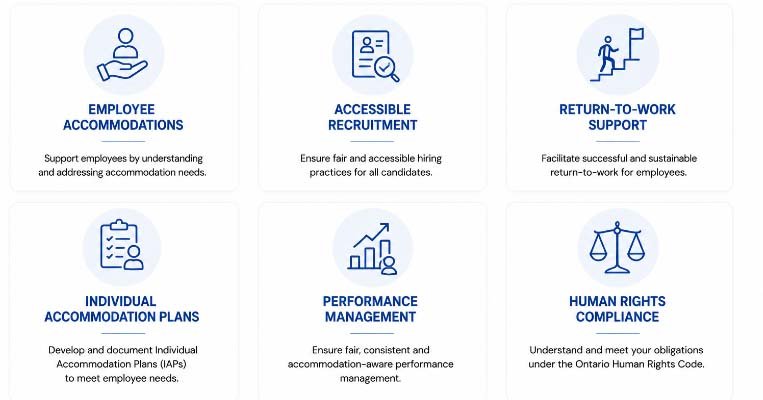
Our AODA training platform includes a dedicated manager module covering all Employment Standard obligations: accessible recruitment, IAPs, return-to-work processes, performance management with accommodation, career development, and the Ontario Human Rights Code. Completed in under 90 minutes with a dated completion certificate.
- Customer Service Standard: four principles, disability interaction, accessible service practices
- Accessible recruitment: accommodation at every stage from job posting to onboarding
- Return-to-work: the documented process and common pitfalls
- Ontario Human Rights Code: duty to accommodate, undue hardship, discrimination and harassment
- IASR Employment Standard: all eight employer obligations in practical terms
- Individual Accommodation Plans: how to initiate, develop, implement, and review
- Performance management with accommodation: accessible standards, the right sequence
- Completion certificate for every manager — dated, downloadable, and role-specific