- IASR Training Guide: What Ontario Employers Need to Know
- 2026 Complete Guide
IASR Training Guide: What Ontario Employers Need to Know
Most Ontario employers know about the Customer Service Standard. Fewer realize that the Integrated Accessibility Standards Regulation — the IASR — imposes its own training requirements on every organization in the province with at least one employee.
Quantity Discounts
Price per course
6 to 20 courses
$20.95
21 to 50 courses
$17.95
51 to 200 courses
$13.95
201+ courses
Custom offer
Most Ontario employers know about the Customer Service Standard. Fewer realize that a second, broader regulation — the Integrated Accessibility Standards Regulation, or IASR — imposes its own training requirements on every organization in the province with at least one employee.
The IASR is not optional, it is not limited to large organizations, and it goes significantly further than Customer Service Standard training alone. This guide explains what the IASR is, what training it requires, who needs it, and how it connects to the other AODA obligations your organization already has.
What is the IASR?

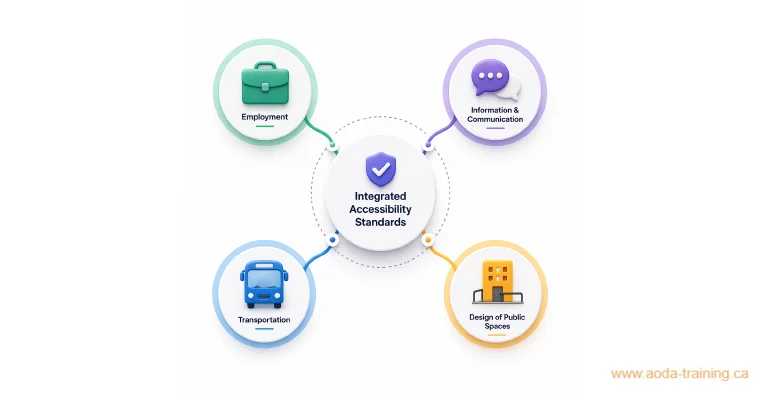
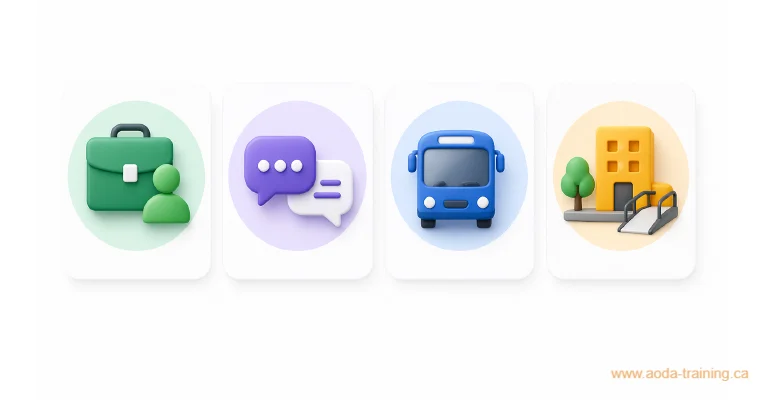
The Integrated Accessibility Standards Regulation — Ontario Regulation 191/11 — came into force in 2011. It consolidated four separate AODA accessibility standards into a single regulation:
Employment Standard
Accessible recruitment, Individual Accommodation Plans (IAPs), return-to-work processes, performance management, and accessible employment information.
Information & Communications Standard
Accessible websites (WCAG 2.0 Level AA), accessible documents, accessible formats on request, emergency procedure information.
Transportation Standard
Accessible transit vehicles, stop announcements, accessibility features for passengers with disabilities.
Design of Public Spaces Standard
Accessible paths of travel, service counters, waiting areas, rest areas, and off-street parking.
For most private-sector businesses and non-profits, the Employment Standard and the Information & Communications Standard are the two IASR components that directly apply.
The Customer Service Standard (Ontario Regulation 429/07) and the IASR (Ontario Regulation 191/11) are separate regulations. The Customer Service Standard focuses on how organizations interact with customers who have disabilities. The IASR covers employment practices, digital accessibility, transportation, and physical spaces. Both regulations apply to your organization. Training must cover both.
The IASR training requirement
Section 7 of the IASR sets out the training obligation. It applies to every organization in Ontario with at least one employee — the same threshold as the Customer Service Standard.
- › The requirements of the IASR that apply to the person's role
- › The Ontario Human Rights Code as it pertains to persons with disabilities
Training must be provided to all employees and volunteers, as soon as practicable after they are assigned their duties, and whenever changes are made to policies, practices, or procedures covered by the IASR.
What IASR training covers by role
The IASR requires that staff are trained “on the requirements of the accessibility standards referred to in this Regulation that apply to that person.” In plain terms: train people on the parts of the IASR that are relevant to their job.
| Role | IASR training content required |
|---|---|
| All employees and volunteers | Overview of the IASR and its four standards. The Ontario Human Rights Code as it relates to disability. General awareness of Employment Standard obligations if in a workplace context. |
| Managers and supervisors | Employment Standard in full: Individual Accommodation Plans (IAPs), accessible recruitment, return-to-work processes, performance management for employees with disabilities, and accessible employment information. |
| HR professionals | All manager content plus: documented accommodation processes, interaction with the Human Rights Tribunal, duty to accommodate vs. undue hardship, handling medical information appropriately. |
| Web developers and IT staff | Information & Communications Standard: WCAG 2.0 Level AA technical requirements, accessible HTML and CSS, keyboard navigation, colour contrast, accessible forms, screen reader compatibility. |
| Content writers and marketers | Information & Communications Standard: writing accessible content, alt text for images, accessible document formats, captions for video, accessible social media practices. |
| Customer service and reception | Employment Standard awareness. Accessible formats — knowing what your organization can provide and how to request them on a customer's behalf. |
| Facilities and operations staff | Design of Public Spaces Standard (if applicable): accessible path of travel maintenance, service counter accessibility, accessible parking and rest areas. |
The Employment Standard: what managers must understand
The Employment Standard is the IASR component with the most direct day-to-day impact on most Ontario organizations. It governs how employers recruit, onboard, manage, and support employees with disabilities.
Accessible recruitment
Job postings must state that accommodation is available during the recruitment process. When a candidate with a disability requests accommodation for an interview or assessment, the employer must provide it. Accessible formats of job postings and assessment materials must be available on request.
Individual Accommodation Plans
Organizations with 50 or more employees must have a written process for developing Individual Accommodation Plans (IAPs) for employees with disabilities. An IAP documents the specific accommodations an employee needs to perform their job — adjusted hours, modified duties, assistive technology, accessible formats of employment information. Plans must be reviewed regularly and updated when circumstances change.
For organizations with fewer than 50 employees, there is no requirement for a formal IAP process, but the duty to accommodate under the Ontario Human Rights Code still applies.
Return-to-work processes
When an employee returns to work following a disability-related absence, the employer must have a documented return-to-work process. This covers how the organization will support the employee’s reintegration, any modifications to duties or schedule, and how IAPs will be reviewed and updated.
Accessible employment information
Employment information — offer letters, training materials, performance reviews, workplace emergency procedures — must be provided in accessible formats on request. Managers and HR staff need to know what formats your organization can provide and how quickly.
The Information & Communications Standard: what digital teams must know
The Information & Communications Standard is the IASR component most relevant to staff who create, manage, or commission digital content.
WCAG 2.0 Level AA
The Standard requires compliance with WCAG 2.0 Level AA. Deadlines have already passed for most organizations:
- Organizations with 50 or more employees: all public-facing websites must meet WCAG 2.0 Level AA (deadline: January 2021)
- Organizations with 1–49 employees: web content created after January 1, 2014 must meet WCAG 2.0 Level AA
Accessible documents and formats
Organizations must provide accessible formats of information on request, at no extra charge, in a timely manner. Accessible formats include large print, Braille, audio, electronic formats compatible with assistive technology, and other formats that meet individual needs.
Emergency procedure information
Workplace emergency procedures must be provided in accessible formats to employees who have disabilities, upon request. Organizations with 50 or more employees must also develop individualized workplace emergency response plans for employees with disabilities who may need assistance during an emergency.
IASR compliance deadlines: where things stand in 2026
Most IASR compliance deadlines have already passed. If your organization has not yet met these requirements, you are currently non-compliant.
| Requirement | Organization size | Deadline |
|---|---|---|
| Employment Standard training | 1+ employees | January 1, 2014 (private/non-profit) |
| Accessible recruitment notices | 1+ employees | January 1, 2014 |
| Individual Accommodation Plan process | 50+ employees | January 1, 2014 |
| Return-to-work process | 50+ employees | January 1, 2014 |
| Accessible employment information | 1+ employees | January 1, 2014 |
| WCAG 2.0 Level AA — new web content | 1–49 employees | January 1, 2014 |
| WCAG 2.0 Level AA — all public-facing content | 50+ employees | January 1, 2021 |
| Accessible formats on request | 1+ employees | January 1, 2016 |
The IASR and the Ontario Human Rights Code
Every IASR training program must include content on the Ontario Human Rights Code as it relates to persons with disabilities. This requirement exists because the IASR and the Human Rights Code overlap significantly, particularly in the employment context.
Employers must accommodate employees with disabilities to the point of undue hardship. This is a higher standard than simply following the IASR — it requires proactive effort to find workable solutions.
An employer can only decline to accommodate when doing so would cause undue hardship. This is a high bar — cost or inconvenience alone is rarely sufficient. Organizations must demonstrate genuine hardship with evidence.
The Code prohibits discrimination on the basis of disability in employment, services, housing, and contracts. Non-compliance with AODA obligations can overlap with discriminatory conduct under the Code.
The Code also prohibits harassment on the basis of disability. IASR training should include what harassment looks like in the context of disability so managers can recognize and address it.
Frequently asked questions
Does the IASR apply to organizations with fewer than 50 employees?
- Yes. The IASR applies to all Ontario organizations with at least one employee. The 50-employee threshold does not determine whether the IASR applies — it determines the scope of specific obligations within it. Organizations with fewer than 50 employees have IASR training and accessibility obligations, but fewer documentation and reporting requirements than larger organizations.
What is the difference between the IASR and the Customer Service Standard?
- The Customer Service Standard (Ontario Regulation 429/07) governs how organizations interact with customers who have disabilities. The IASR (Ontario Regulation 191/11) covers employment practices, digital accessibility, transportation, and physical spaces. Both regulations are mandatory for all Ontario employers. Training must cover both.
Do I need an Individual Accommodation Plan for every employee with a disability?
- Organizations with 50 or more employees must have a documented process for creating IAPs. An actual IAP is only developed when an employee with a disability requests one or when the need for accommodation becomes apparent. You do not need to create IAPs proactively for all employees with disabilities — but you must have the process ready and must respond when accommodation is needed.
Is WCAG 2.0 Level AA still the current requirement under AODA?
- Yes, as of 2026. Ontario’s AODA currently requires WCAG 2.0 Level AA for websites. The Ontario government has been consulting on updating this requirement to align with WCAG 2.1 or 2.2, but no regulatory change has been confirmed at the time of writing. Organizations should monitor government announcements and be prepared to update their digital accessibility training when the standard is updated.
Can IASR training be combined with Customer Service Standard training?
- Yes, and for most organizations this is the most practical approach. A well-designed AODA training program covers both the Customer Service Standard requirements and the relevant parts of the IASR in a single course or course sequence. Role-specific modules can address Employment Standard or Information & Communications Standard content for staff who need it.
What happens if we have not yet met our IASR obligations?
- If your IASR deadlines have passed and obligations have not been met, the organization is currently non-compliant. The Ontario government audits organizations and can issue compliance orders. Fines for non-compliance can reach $100,000 per day for organizations and $50,000 per day for individuals. Prioritize the highest-risk gaps — typically training and accessible recruitment — and document remediation steps taken.
Empower Your Team with Digital Accessibility
Ensure compliance, reduce legal risks, and build inclusive digital experiences.
Start AODA training for your team →Get your team IASR compliant
IASR compliance starts with training — making sure every staff member understands what the regulation requires for their role, and that managers understand the Employment Standard obligations they personally carry.
- All-staff IASR overview including Ontario Human Rights Code content
- Information & Communications module: WCAG 2.0 Level AA, accessible documents
- Completion certificates and audit-ready records for every staff member
- Employment Standard module: IAPs, accessible recruitment, return-to-work
- Manager-specific guidance on accommodation, duty to accommodate, undue hardship
- Updated when Ontario accessibility standards change