
- AODA Training
AODA Customer Service Standard Training: Requirements & Guide
The Customer Service Standard is the AODA obligation that applies to every Ontario employer with at least one employee — no exceptions. It requires organizations to train all staff on how to provide accessible service to people with disabilities, grounded in four core principles.
Quantity Discounts
Price per course
6 to 20 courses
$20.95
21 to 50 courses
$17.95
51 to 200 courses
$13.95
201+ courses
Custom offer
The Customer Service Standard is the AODA obligation that applies to every Ontario employer with at least one employee — no exceptions. It requires organizations to train all staff on how to provide accessible service to people with disabilities, grounded in four core principles that define what accessible customer service actually means in practice.
This page explains what the Standard requires, what training must cover, how to deliver it correctly, and what it looks like when it is done well versus when it falls short.
What is the AODA Customer Service Standard?
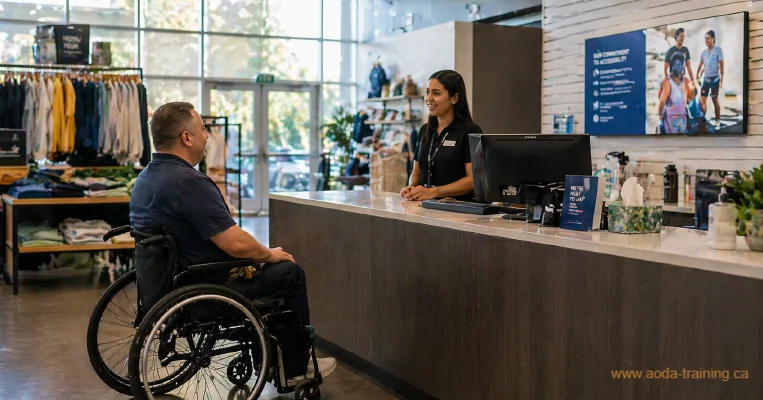
The Customer Service Standard — formally Ontario Regulation 429/07 — came into force on January 1, 2008, for designated public sector organizations, and January 1, 2012, for all other organizations with at least one employee. It was the first AODA standard to take effect and remains the most universally applicable.
The Standard requires organizations to:
- Establish policies, practices, and procedures for providing accessible customer service
- Train all staff, volunteers, and contractors on those policies and on the Standard itself
- Have a process for receiving and responding to accessibility feedback from customers
- Notify customers when a service or facility used by people with disabilities is temporarily disrupted
- Permit the use of personal assistive devices, service animals, and support persons
Every organization in Ontario with at least one employee — private sector, non-profit, public sector, and government — must comply with the Customer Service Standard. There is no industry exemption, no revenue threshold, and no size minimum. The only entity not covered is a sole trader with no employees.
The four core principles of accessible customer service
The Customer Service Standard is built around four principles. Every element of accessible service delivery flows from these principles, and training must ensure staff understand not just what the principles are, but what they mean in practice.
Dignity
People with disabilities must be served in a way that respects who they are — not treated as less capable, not made to feel like a burden, and not drawing unnecessary attention to their disability.
- Speak directly to the customer, not to their support person
- Do not refer to a customer's disability unless they raise it
- Offer assistance — but do not insist if the offer is declined
- Do not rush a customer because they take longer to complete a transaction
Independence
Wherever possible, people with disabilities should be able to access services on their own terms and at their own pace, without requiring help they have not asked for.
- Allow extra time for customers to complete a transaction without hovering
- Do not move or touch a customer's assistive device without permission
- Do not automatically assume a customer needs assistance
- Ensure pathways and service areas are physically accessible without staff intervention
Integration
People with disabilities should be able to access services in the same place and the same manner as other customers, wherever this is reasonably possible. Separate services are only acceptable when integration is genuinely not achievable.
- Serve a customer who uses a wheelchair at the same counter as everyone else
- Provide the same information to a customer who requests an accessible format — not a summary
- Avoid creating 'accessible' service lanes that feel inferior or inconvenient
Equal opportunity
People with disabilities must have the same opportunity to benefit from your goods, services, and facilities as people without disabilities. The outcome should be equivalent, even if the method of delivery differs.
- If a format is not accessible, offer an alternative that provides the same information
- Do not charge extra for an accessible format or accommodation
- If a process cannot be made accessible, find an equivalent alternative
What Customer Service Standard training must cover
The regulation specifies the content that training must address. Generic accessibility awareness training does not satisfy this requirement unless it includes all of the following.
- › The purposes of AODA and the requirements of the Customer Service Standard
- › How to interact and communicate with people who have various types of disability
- › How to interact with people who use assistive devices or require the assistance of a guide dog, service animal, or support person
- › How to use the equipment or devices available on the premises that may help people with disabilities access goods or services
- › What to do if a person with a disability is having difficulty accessing your goods or services
- › Your organization's policies, practices, and procedures relating to the Customer Service Standard
Accessible customer service in practice: common scenarios
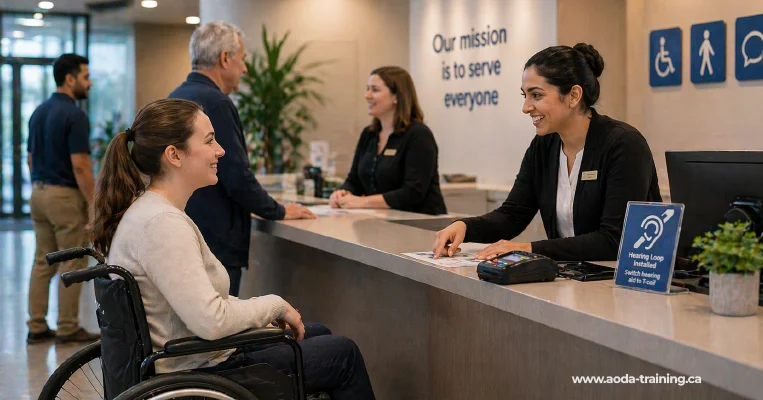
Understanding the four principles is necessary but not sufficient. Staff need to know what they mean in real situations. Training that includes practical scenarios is significantly more effective than theory alone.
Customers using wheelchairs or mobility aids
Ensure service counters are accessible at wheelchair height where possible. If not, offer an equivalent alternative — a portable counter, a different location, or table service. Do not make a customer with a mobility aid feel that the accessible option is a lesser version of the standard service. Ask if assistance is needed with doors, but respect the answer.
Customers who are Deaf or hard of hearing
Face the customer when speaking. Speak clearly and at a natural pace — do not exaggerate lip movements, as this makes lip-reading harder. If verbal communication is not working, offer to write things down or use a communication app. Be aware that not all Deaf customers use lip-reading; some communicate through sign language or written text. If your organization has a TTY device, staff must know how to use it.
Customers with visual impairments
Identify yourself when you approach. Do not touch or redirect a guide dog without the owner’s permission — a guide dog is working and distractions can be dangerous. When providing written information, ask whether the customer needs it in an accessible format and know what formats your organization can provide (large print, electronic, audio). Offer to read aloud any information that is only available in print.
Customers using support persons
A person with a disability is entitled to have a support person with them when accessing your services. You cannot refuse access to a support person or charge an extra fee for their presence — unless the fee is for admission to the premises, in which case your accessibility policy must state this and you must provide advance notice. Speak to the customer, not to the support person, unless the customer directs otherwise.
Service disruptions
When a service or facility that people with disabilities depend on is temporarily unavailable — an accessible entrance blocked, a ramp under repair, a TTY out of service — the Standard requires you to post notice of the disruption and provide information about alternative options. Staff must know your organization’s disruption notification procedure and be able to direct affected customers to alternatives.
- › New employee or volunteer: Customer Service Standard + IASR training on or before day one
- › Policy change: updated training re-delivered to all affected staff within 30 days of the change
- › Role change: role-specific training updated before or on the day the new role begins
- › Review training content against your current accessibility policies — update if anything has changed
- › Check for AODA regulatory updates and WCAG guidance changes
- › Confirm training records are complete and up to date for all current staff
- › Identify any staff who have changed roles and confirm their training reflects current obligations
- › Refresher training for long-serving customer-facing staff, even if no policy changes have occurred
- › Full training review for any staff with WCAG or Employment Standard obligations
This schedule is practical for organizations of any size. Smaller businesses can run the annual review in under an hour. Larger organizations can assign the review to an HR or compliance lead and use their training platform’s reporting tools to identify gaps automatically.
Who needs Customer Service Standard training?
The Customer Service Standard training requirement applies broadly. It is not limited to staff who serve customers face to face.
| Who | Training required? | Notes |
|---|---|---|
| Full-time employees | Yes | All staff, regardless of role or whether they interact with customers |
| Part-time employees | Yes | No hours threshold — part-time staff have the same obligation as full-time |
| Seasonal and casual staff | Yes | Must be trained before or as soon as they begin their role |
| Volunteers | Yes | Applies to volunteers who interact with the public or help develop policies |
| Third-party contractors | Yes | If they deliver services to your customers on your behalf |
| Policy developers | Yes | Anyone involved in developing, implementing, or enforcing accessibility policies |
| Remote employees | Yes | Physical location does not affect the obligation |
| Directors and officers | Yes | They bear personal liability for organizational compliance |
Delivering Customer Service Standard training effectively
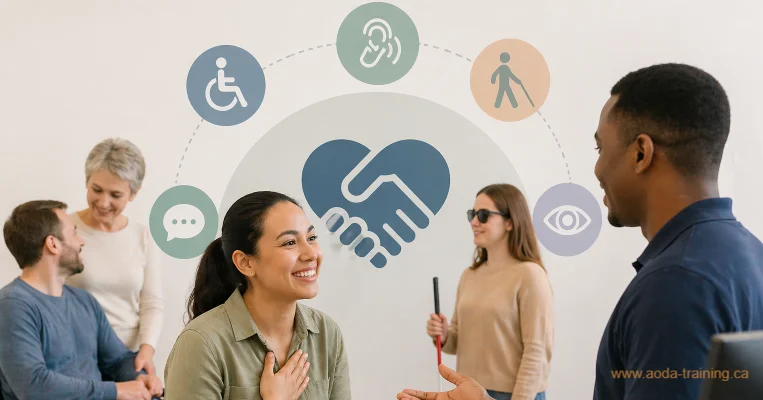
The law specifies what training must cover but not how it must be delivered. The format is up to you — online course, in-person workshop, written materials, or a combination. What matters is that staff can demonstrate they have understood the content, not just that they sat through it.
Online training
The most common delivery method. Online courses are practical for organizations of any size, allow staff to complete training at their own pace, and generate completion records automatically on most platforms. The gap with online-only training is the policy content requirement — choose a platform that lets you add your organization’s specific policies, or supplement the course with a written policy review.
Scenario-based training
Training that includes practical scenarios is consistently more effective than theory-only content. Staff who have worked through realistic situations — what to do when a customer’s guide dog is distressed, how to handle a service disruption when a customer with a visual impairment is waiting — are more likely to respond appropriately when those situations arise. If your training does not include scenarios, consider adding a facilitated discussion as a follow-up.
Refresher and onboarding integration
Customer Service Standard training should be part of every new hire’s first day or first week. Build it into your onboarding checklist so it happens automatically, not as an afterthought. For existing staff, retraining is required when your policies change — a targeted refresher on the changed content is sufficient if the rest of the training remains accurate.
Common Customer Service Standard compliance gaps
Most AODA Customer Service Standard compliance failures are not intentional. They typically fall into a small number of patterns.
- › Training was delivered once when AODA came into force, but not to staff hired since then
- › Training covers the Standard's generic content but not the organization's own accessibility policies
- › Only frontline staff were trained — back-office, remote, and management staff were not included
- › Volunteers and contractors were not trained because they were not considered employees
- › Training was updated when policies changed, but not re-delivered to existing staff
- › No records were kept, so there is no way to demonstrate compliance in an audit
- › Staff received a document to read and sign rather than actual training on the content
Frequently asked questions
What are the four principles of the AODA Customer Service Standard?
- The four principles are dignity, independence, integration, and equal opportunity. Dignity means treating customers with respect. Independence means allowing customers to access services on their own terms. Integration means providing services in the same way as other customers wherever possible. Equal opportunity means ensuring the outcome of service delivery is equivalent, even if the method differs.
Is the Customer Service Standard the same as the IASR?
- No. The Customer Service Standard (Ontario Regulation 429/07) and the Integrated Accessibility Standards Regulation or IASR (Ontario Regulation 191/11) are separate regulations. The Customer Service Standard focuses specifically on service delivery. The IASR covers Employment, Information and Communications, Transportation, and Design of Public Spaces. Organizations must comply with both, and training must cover both.
Can I hand staff a copy of our accessibility policy and call it training?
- No. Handing staff a document to read does not meet the training requirement. The Customer Service Standard requires training on the content of the Standard and your policies — not simply distribution of a document. Staff need to demonstrate they have understood the material, which requires an interactive or instructional format, not just a signature page.
Do I need to train staff on accessibility if we do not have a physical storefront?
- Yes. The Customer Service Standard applies to any organization that provides goods, services, or facilities to members of the public, regardless of whether it operates from a physical location. Online businesses, professional services firms, and remote-first organizations all have obligations under the Standard. If your organization has customers, the Standard applies.
What should I do if a customer with a disability has a complaint about our service?
- The Customer Service Standard requires you to have a process for receiving and responding to accessibility feedback. When a complaint is received, respond in a way that reflects the principles of dignity and equal opportunity. Complaints should be documented and used to improve your policies and training. If your organization does not yet have a formal feedback process, creating one is a compliance requirement, not optional.
Does the Customer Service Standard cover digital services?
- The Customer Service Standard primarily governs in-person and direct service interactions. Digital accessibility — website accessibility, accessible documents, and digital communications — is governed by the Information and Communications Standard under the IASR. However, the Customer Service Standard’s principle of equal opportunity applies to all service channels, including digital ones.
- AODA Information & Communications Training for Digital Teams
Empower Your Team with Digital Accessibility
Ensure compliance, reduce legal risks, and build inclusive digital experiences.
Start AODA training for your team →Train your team on the Customer Service Standard
Our Customer Service Standard training covers all the required content — the four principles, disability-specific interaction guidance, assistive devices, service animals, support persons, disruption procedures, and your organization’s specific accessibility policies — in a single online course with automatic records.
- All six mandatory content areas under Ontario Regulation 429/07
- Your organization's specific accessibility policies embedded in the course
- Automatic training records — audit-ready and exportable
- Practical scenarios covering the most common accessible service situations
- Completion certificate for every staff member, dated and downloadable
- Compatible with your onboarding workflow so new hires are trained from day one