
- Free vs Paid AODA Training in Ontario
- AODA Training
Free vs Paid AODA Training in Ontario: Which Is Right for You?
Ontario employers have more than one option when it comes to AODA training. The government offers a free training module. Several private platforms offer paid courses with more features, more content, and better record-keeping. This page helps you decide which is right for your organization.
Quantity Discounts
Price per course
6 to 20 courses
$20.95
21 to 50 courses
$17.95
51 to 200 courses
$13.95
201+ courses
Custom offer
Ontario employers have more than one option when it comes to AODA training. The government offers a free training module. Several private platforms offer paid courses with more features, more content, and better record-keeping. The question is not which one is better in the abstract — it is which one is right for your organization’s size, structure, and compliance needs.
This page explains what the free option covers, where it stops, what paid platforms add, and how to decide which approach makes sense for your business.
The free option: Ontario's AccessForward training
The Ontario government provides free AODA training through a platform called AccessForward (accessforward.ca). It was developed to help Ontario organizations meet the Customer Service Standard training requirement without a financial barrier.
What AccessForward covers
- An introduction to AODA and its purpose
- The Customer Service Standard — the four principles (dignity, independence, integration, equal opportunity)
- How to interact with people who have various types of disability
- How to work with people who use assistive devices, service animals, or support persons
- General information about the Integrated Accessibility Standards Regulation (IASR)
For a business with a small team, straightforward customer service operations, and no complex accessibility obligations, AccessForward may be sufficient for the Customer Service Standard requirement.
What Access Forward does not cover
- › Your organization's specific accessibility policies — required content under the Customer Service Standard
- › Role-specific training for managers, HR, IT, or content teams
- › Employment Standard training (Individual Accommodation Plans, accessible recruitment, return-to-work)
- › Information & Communications Standard training (WCAG 2.0 Level AA, accessible documents)
- › Automated completion tracking or audit-ready records
- › Branded certificates with your organization's name
- › Bulk enrollment or team management features
What paid AODA training platforms offer
Paid AODA training platforms are designed for organizations that need more than a baseline course. The core difference is not the quality of the accessibility content — it is the layer of features built around it.
Policy integration
Most paid platforms let you add your own policy content to the course, satisfying the Customer Service Standard requirement in full in a single session.
Role-specific modules
Separate modules for different roles — frontline, manager, IT/developer. Staff complete only the training relevant to their role.
Automated record-keeping
Completion data stored centrally, exportable for audits, tied to each employee's profile. For 50+ employee organizations, this removes a significant administrative burden.
Completion certificates
Branded certificates for each staff member with name, course completed, date, and unique certificate number.
Bulk enrollment & team management
Bulk enrollment, manager dashboards to track team completion, automated reminders, and reporting tools.
Onboarding integration
Assign training to new hires on day one as part of your standard onboarding flow — automated and reliable.
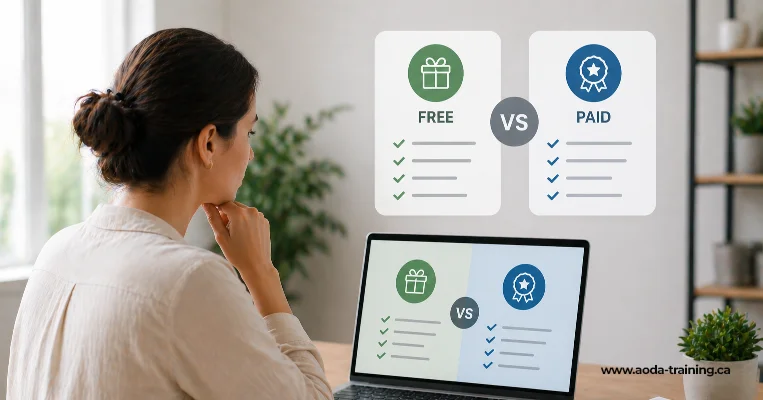
Free vs paid: side-by-side comparison
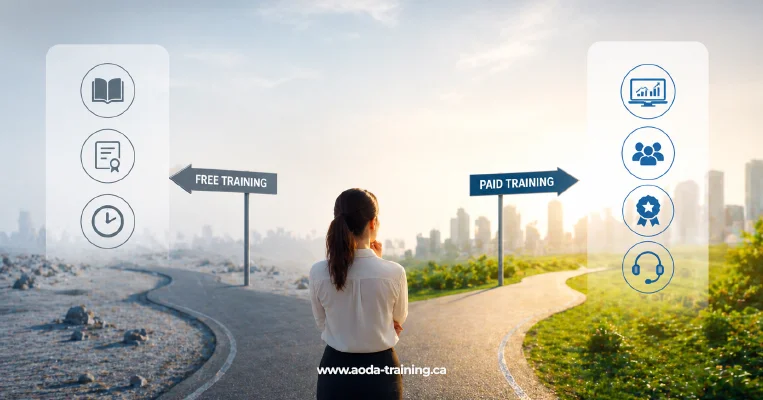
When the free option is the right choice
- › You have fewer than 10 employees
- › Your team's customer interactions are straightforward and do not involve complex accommodation scenarios
- › You do not have staff in roles with specific IASR obligations (HR, IT, content creation)
- › You are prepared to supplement the course with a separate policy briefing covering your organization's specific accessibility policies
- › You are comfortable managing completion records manually (screenshots, spreadsheet log)
- › You do not need to demonstrate bulk compliance quickly — for example, ahead of a compliance review
When a paid platform is the better choice
- › You have 10 or more employees and need to coordinate training across your team
- › You have staff in roles with Employment Standard or WCAG obligations (managers, HR, IT, content)
- › Your organization has 50 or more employees and is legally required to keep training records
- › You are growing and regularly onboarding new staff — manual training administration becomes a burden quickly
- › You have had an AODA compliance review or received a complaint and need to demonstrate records
- › You want a single platform that handles Customer Service, IASR, and role-specific training in one place
- › You want your organization's specific policies embedded in the course rather than delivered separately
Questions to ask before choosing an AODA training provider
| Question | Why it matters |
|---|---|
| Does the course include content about our specific accessibility policies, or can we add them? | Required under the Customer Service Standard. If not included, you need to supplement training separately. |
| Does the course cover the IASR, including the Ontario Human Rights Code? | Mandatory for all Ontario employers. Many generic 'AODA awareness' courses skip this. |
| Are there role-specific modules for managers, HR, and digital teams? | Different roles have different legal obligations. Generic training may not satisfy all of them. |
| What records does the platform generate, and in what format? | You need records that show who was trained, when, and what the training covered. Check the export format. |
| Can we assign training to new hires automatically as part of onboarding? | Training should happen on or before day one. A platform that integrates with onboarding makes this reliable. |
| How is the course updated when regulations change? | AODA standards continue to evolve. Your training content needs to reflect current requirements. |
Frequently asked questions
Is the free AccessForward training legally compliant for AODA purposes?
- For the Customer Service Standard, yes — with one caveat. AccessForward covers the required content under the Standard, but it does not include your organization’s specific accessibility policies. You need to supplement AccessForward with a policy briefing or have staff review your policy separately and document that they have done so.
Does free AODA training satisfy the IASR requirement?
- AccessForward provides a general overview of the IASR but does not cover the full IASR training requirement, particularly for managers and HR professionals who have specific obligations around Individual Accommodation Plans and accessible recruitment. For staff with HR, management, or digital content responsibilities, dedicated IASR training is needed.
Can I mix free and paid training — for example, free for some staff and paid for others?
- Yes. There is no requirement to use a single training provider across your organization. Many businesses use the free government course for general staff and a paid platform for managers, HR, and IT teams who have additional obligations. The key is that every person receives training that covers everything legally required for their role.
Do I need to keep records if I use the free training?
- Organizations with 50 or more employees are legally required to keep training records regardless of which course they use. With AccessForward, records are not generated automatically — you need to manage them manually, typically by keeping screenshots of completion pages or a spreadsheet log with each staff member’s name, completion date, and the course they completed.
Is there a government-recommended paid training provider?
- The Ontario government does not endorse or recommend specific private training providers. The free AccessForward platform is the only government-backed training option. For paid options, you need to evaluate providers independently. Look for providers who clearly state their courses meet the Customer Service Standard and IASR requirements, and who can show you a sample course before you commit.
Empower Your Team with Digital Accessibility
Ensure compliance, reduce legal risks, and build inclusive digital experiences.
Start AODA training for your team →Find the right training for your team
Our online AODA training courses are designed for Ontario businesses that need more than the free government module — without paying for features they will never use.
- Customer Service Standard training with your organization's policy content built in
- Role-specific modules: managers, HR, IT and web teams, frontline staff
- Audit-ready records: searchable, exportable, always up to date
- IASR training including the Ontario Human Rights Code
- Completion certificates for every employee — branded and dated
- Updated when Ontario accessibility standards change