
- AODA Certification: How Long Does It Last? (2026 Guide)
- AODA Training
AODA Certification: How Long Does It Last? (2026 Guide)
AODA training in Ontario has no fixed expiry date. The legislation does not require annual recertification or a renewal every two or three years. What it does require is that training remains current and that staff are retrained whenever certain triggers occur.
Quantity Discounts
Price per course
6 to 20 courses
$20.95
21 to 50 courses
$17.95
51 to 200 courses
$13.95
201+ courses
Custom offer
The most common version of this question is: “We did AODA training a few years ago — do we need to do it again?” The answer depends on what has changed since that training happened, not on how much time has passed.
AODA training in Ontario has no fixed expiry date. The legislation does not require annual recertification or a renewal every two or three years. What it does require is that training remains current and that staff are retrained whenever certain triggers occur.
AODA training has no fixed expiry date
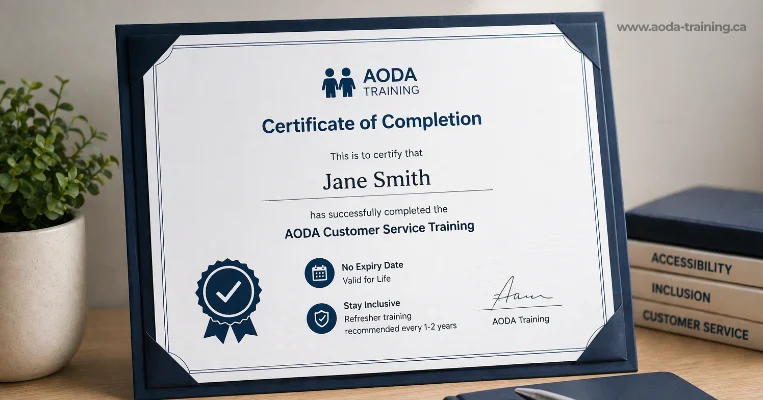
Neither the Customer Service Standard nor the Integrated Accessibility Standards Regulation (IASR) sets a renewal period for AODA training. There is no rule in Ontario law that says training expires after one year, two years, or any other fixed interval.
This surprises many employers, partly because other workplace compliance training — first aid, WHMIS, health and safety — typically has defined renewal periods. AODA is different. The legal standard is that training must be provided when it first applies to an organization, and then maintained so that it remains accurate and current.
Requires that every person receive training "as soon as practicable" after starting, and that training is "provided to a person with respect to any changes to the policies, practices and procedures of the service provider."
Adds that training must be provided "on the requirements of the accessibility standards referred to in this Regulation that apply to that person and on the Ontario Human Rights Code, as it pertains to persons with disabilities."
Neither regulation prescribes a fixed renewal interval. The obligation is to keep training current, not to renew it on a schedule.
What triggers a retraining requirement
Even without a fixed expiry, retraining is legally required in several specific situations. Understanding these triggers is the key to maintaining compliance without unnecessary repetition.
| Trigger | Who it affects | What to do |
|---|---|---|
| New employee or volunteer starts | The individual starting | Train on Customer Service Standard and IASR before or on their start date, or as soon as practicable after. |
| Accessibility policy changes | All staff affected by the policy change | Update training content to reflect the new policy and re-deliver to affected staff. Partial updates are acceptable if the rest remains accurate. |
| Staff member moves to a new role | The individual changing roles | If the new role carries different accessibility obligations (e.g. frontline worker becomes manager), role-specific training must be updated. |
| AODA regulations are amended | All staff whose obligations are affected | Update training to reflect the regulatory change and re-deliver. Ontario typically provides advance notice of significant regulatory updates. |
| New assistive technology or equipment introduced | Staff who will interact with the equipment | Provide training on how to assist customers using the new device or technology. |
| New service disruption procedures | All staff who need to communicate disruptions to customers | Update and re-deliver training on your disruption notification process. |
Best practice: beyond the legal minimum
Meeting the legal minimum means training staff when they start, and retraining when triggers occur. Best practice goes a step further — not because the law requires it, but because it reduces the risk of gaps forming between training events.
Annual content review
Even if no formal retraining is required, reviewing your AODA training content once a year is sensible. Check whether your accessibility policies have changed, whether any regulatory updates have been announced, and whether any new assistive devices or services have been introduced. If nothing has changed, no action is needed. If something has, you can plan a targeted refresher rather than discovering the gap during an audit.
Refresher training for long-serving staff
Staff who completed AODA training several years ago and have not been retrained since may have forgotten key content — particularly if the training was a one-off session with no follow-up. For organizations where accessible customer service is central to day-to-day operations, a refresher every two to three years is reasonable even if not legally required. This is especially true for staff in frontline roles.
Training as part of performance conversations
Accessibility obligations are easier to sustain when integrated into how your organization talks about performance and standards rather than treated as a one-time compliance exercise. Including accessibility in onboarding, team briefings, and manager check-ins keeps it front of mind without requiring formal retraining.
Keeping pace with WCAG updates
For organizations with website or digital content obligations under the Information and Communications Standard, accessibility standards are moving targets. Ontario’s AODA currently requires WCAG 2.0 Level AA compliance, but the government has been consulting on alignment with WCAG 2.1 and 2.2. Staff involved in creating or managing digital content should have their training reviewed whenever WCAG guidance is updated, even if the regulatory requirement has not yet changed.
How to build a practical AODA training schedule

A workable training schedule does not need to be complicated. The following framework covers the legal requirements and adds a lightweight annual review that keeps everything current.
- › New employee or volunteer: Customer Service Standard + IASR training on or before day one
- › Policy change: updated training re-delivered to all affected staff within 30 days of the change
- › Role change: role-specific training updated before or on the day the new role begins
- › Review training content against your current accessibility policies — update if anything has changed
- › Check for AODA regulatory updates and WCAG guidance changes
- › Confirm training records are complete and up to date for all current staff
- › Identify any staff who have changed roles and confirm their training reflects current obligations
- › Refresher training for long-serving customer-facing staff, even if no policy changes have occurred
- › Full training review for any staff with WCAG or Employment Standard obligations
This schedule is practical for organizations of any size. Smaller businesses can run the annual review in under an hour. Larger organizations can assign the review to an HR or compliance lead and use their training platform’s reporting tools to identify gaps automatically.
AODA training certificates: what they show and how long to keep them
An AODA training certificate is a record that a specific person completed a specific course on a specific date. The certificate itself does not expire — it is a historical record. Whether the training it represents is still current depends on whether any retraining triggers have occurred since the certificate was issued.
What a compliant certificate should show
- The employee's full name
- The name of the course completed and the standard it covers
- The date of completion
- The organization's name (for in-house training) or the provider's name (for third-party training)
- A unique certificate number or reference (on most paid platforms)
How long to keep training records
AODA does not specify a retention period for training records. The practical guidance from compliance advisors is to keep records for the duration of an employee’s tenure plus at least two years after they leave. For organizations with 50 or more employees, a central training register — whether in an HR system, a spreadsheet, or a training platform — is the most defensible approach.
What to do if records cannot be found for existing staff
If you cannot locate training records for staff who have been with your organization for years, the safest approach is to treat them as untrained and deliver training again. The risk of assuming training happened without being able to prove it outweighs the cost of a refresher.
- › Keep records for all staff who have completed training
- › Include name, role, course, date, and standard covered in each record
- › Store records in a central location accessible for audit purposes
- › Retain records for at least 2 years after an employee leaves
- › If records are missing for existing staff, retrain and document from now
- › For 50+ employee organizations, records are a legal requirement — not optional
Common misconceptions about AODA certification
| Misconception | The reality |
|---|---|
| "Our staff were trained once in 2015 — that still counts." | It depends. If your accessibility policies have not changed and no regulatory updates have occurred since then, the original training may still be technically compliant. In practice, policies have almost certainly changed, which means retraining is overdue. |
| "AODA training needs to be renewed every year." | Not under the law. Annual renewal is a reasonable best practice for some roles, but it is not a legal requirement. Retraining is triggered by specific events, not by the calendar. |
| "If the certificate is dated, the training is still valid." | The certificate records what happened on that date. It does not guarantee the training is still current. If policies or regulations have changed since the certificate was issued, the training it represents is outdated. |
| "We only need to retrain staff who interact with customers." | Everyone covered by the Customer Service Standard needs training, regardless of whether they interact with customers directly. Back-office staff, remote workers, and volunteers are all included. |
| "If we use a paid platform, the certificates auto-renew." | Paid platforms manage records and can issue new certificates when staff retake a course. They do not automatically determine when retraining is legally required — that judgment still rests with the employer. |
Frequently asked questions
Does AODA training expire after a certain number of years?
- No. AODA legislation does not set a fixed expiry period for training. Certificates do not expire on a schedule. Training becomes outdated when specific triggers occur — primarily policy changes, regulatory updates, role changes, or new assistive devices — not because time has passed.
If an employee did AODA training at a previous employer, does it count?
- Partially. Training completed at a previous employer demonstrates that the person has been exposed to the Customer Service Standard and IASR content. However, it almost certainly does not include your organization’s specific accessibility policies, which is a required element of the training. A policy briefing at minimum is needed, and in most cases a full refresher is the cleaner approach.
How often should managers be retrained?
- Managers have broader AODA obligations than frontline staff, covering Individual Accommodation Plans, accessible recruitment, and return-to-work processes under the Employment Standard. They should be retrained whenever your organization’s accommodation policies change, when Ontario updates its Employment Standard guidance, or when they take on new responsibilities. A check-in every two years is reasonable for managers in active HR roles.
Do staff who work remotely need the same retraining as on-site staff?
- Yes. Remote employees are covered by AODA training requirements in the same way as on-site staff. The training format can be online, which makes delivery straightforward. Their obligations under the Customer Service Standard and IASR do not change based on where they work.
What should I do if a staff member's training records have been lost?
- Retrain them and document it properly this time. You cannot demonstrate compliance without records, and claiming that training happened years ago without evidence is not a defensible position in an audit or complaint investigation. The cost of a refresher course is far lower than the risk of appearing non-compliant.
Should I retrain all staff when AODA regulations are updated?
- Only staff whose obligations are directly affected by the update. If the Ontario government updates web accessibility requirements, that primarily affects staff who create or manage digital content — not every employee. Identify which staff are affected by the specific regulatory change and target retraining accordingly.
Empower Your Team with Digital Accessibility
Ensure compliance, reduce legal risks, and build inclusive digital experiences.
Start AODA training for your team →Keep your team's training current
The simplest way to stay on top of AODA training currency is to have a system that tracks who has trained, when they trained, and what triggers have occurred since. Our platform handles all of that automatically.
- Completion certificates dated and stored for every staff member
- Policy update notifications so you know when to schedule a refresher
- Role-based courses so managers, HR, and digital teams meet their obligations
- Automatic reminders when new hires have not yet completed training
- Training records exportable for audit purposes at any time
- Updated course content whenever Ontario accessibility standards change