
- AODA Training Guide
AODA Training: Complete Guide for Ontario Businesses (2026)
If your business operates in Ontario, AODA training is not something you can schedule for later. The Accessibility for Ontarians with Disabilities Act requires every organization with at least one employee to train its staff on accessibility — and has done so since the Customer Service Standard came into force in 2010.
Quantity Discounts
Price per course
6 to 20 courses
$20.95
21 to 50 courses
$17.95
51 to 200 courses
$13.95
201+ courses
Custom offer
The law is not complicated. But plenty of Ontario businesses are still not fully compliant, either because they are not sure what training is required, who needs it, or how to prove they have done it. This guide answers all of that.
By the end you will know exactly what AODA training covers, who in your organization needs which type of training, when it has to happen, and how to avoid the fines that come with getting it wrong.
What is AODA?

The Accessibility for Ontarians with Disabilities Act became law in 2005. Its purpose was straightforward: make Ontario fully accessible to people with disabilities by 2025, by requiring organizations to identify, remove, and prevent accessibility barriers.
Around 2.6 million people in Ontario live with a disability. That includes people with physical disabilities, visual or hearing impairments, learning disabilities, mental health conditions, and age-related conditions. AODA exists because many of the barriers these individuals face are not inevitable — they are just the result of systems and services being designed without them in mind.
2.6M
Ontarians living with a disability
2005
Year AODA became law
5
AODA standards covering daily life
The Act works through five standards, each covering a different part of daily life:
| Standard | What it governs | Who it mainly affects |
|---|---|---|
| Customer Service | How organizations interact with customers and clients who have disabilities | All Ontario businesses |
| Employment | Hiring, onboarding, accommodation, and workplace practices for employees with disabilities | All Ontario employers |
| Information & Communications | Accessible websites, documents, and digital content | Organizations with websites or digital content |
| Transportation | Accessible transit services and vehicles | Transit operators and providers |
| Design of Public Spaces | Accessible outdoor spaces, paths of travel, service counters, and rest areas | Organizations managing public spaces |
Most Ontario businesses need to meet the Customer Service and Employment standards at minimum. Organizations with 50 or more employees have broader obligations under the Integrated Accessibility Standards Regulation (IASR), which bundles Employment, Information & Communications, Transportation, and Design of Public Spaces into one regulation.
Who needs AODA training in Ontario?
The short answer is almost everyone who works for or with an Ontario organization. There is no minimum employee count that triggers the training requirement. A sole trader with one part-time staff member has the same Customer Service Standard training obligation as a company with 500 employees.
Under the AODA, training is mandatory for:
All employees
Full-time, part-time, seasonal, and casual — without exception.
Volunteers
Those who interact with the public or participate in policy development.
Third-party contractors
Anyone delivering services on behalf of your organization.
Policy developers
Anyone involved in developing, implementing, or enforcing your accessibility policies.
The type of training required depends on what a person does. Frontline staff interacting with customers need Customer Service Standard training. Managers and HR teams need Employment Standard training. Developers, content writers, and communications staff need to understand the Information and Communications Standard, particularly WCAG web accessibility requirements.
If you are unsure which staff need which type of training, the simplest approach is to train everyone on the Customer Service Standard as a baseline, then layer on role-specific modules for people in management, HR, IT, or content roles.
What does AODA training cover?
AODA training is not a single course. It is a set of requirements, and the content that satisfies those requirements varies by standard and by role. Here is what each major training area covers.
Customer Service Standard training
This is the training that applies to every Ontario business with at least one employee. The Customer Service Standard requires organizations to train staff on how to serve customers with disabilities in a way that respects their dignity and independence.
The training covers four core principles that underpin all accessible customer service:
Dignity
Treat people with disabilities as valued customers. Do not make them feel burdensome or separate.
Independence
Allow people to do things in their own way and at their own pace, without unnecessary assistance unless requested.
Integration
Where possible, provide services in a way that allows people with disabilities to access them in the same place and manner as other customers.
Equal opportunity
People with disabilities should have the same opportunity to benefit from your services as everyone else.
Beyond the principles, Customer Service training covers how to interact with people who use assistive devices such as wheelchairs, white canes, or hearing aids; how to communicate with someone who uses a support person or service animal; and how to respond when a customer asks for accessible formats or communication supports.
It also covers your organization’s specific accessibility policies — what you do when a service is temporarily disrupted, how you receive and respond to accessibility-related feedback, and how staff are expected to behave.
IASR training (50+ employees)
Organizations with 50 or more employees must also train staff on the Integrated Accessibility Standards Regulation and the Ontario Human Rights Code as it relates to disability. This is separate from Customer Service training and goes deeper into the legal framework.
IASR training covers the Employment Standard in detail — individual accommodation plans, return-to-work processes, performance management practices, and accessible recruitment. It also covers the Information and Communications Standard, which includes requirements around accessible documents, websites, and emergency procedures.
For organizations subject to the IASR, training must happen when the regulation first applies to your organization, and again whenever responsibilities change or regulations are updated.
Employment Standard training
Managers and HR professionals need to understand how AODA interacts with their day-to-day responsibilities. This includes knowing when an employee is entitled to an Individual Accommodation Plan, how to conduct accessible job interviews, and what accessible formats of employment information mean in practice — offer letters, training materials, emergency procedures.
Employment Standard training also covers the return-to-work process for employees who have been absent due to disability. Getting this wrong is one of the more common compliance failures, and it carries real legal exposure under both AODA and the Ontario Human Rights Code.
AODA training requirements for employers
The law is specific about what you need to have in place. Here is the full picture.
- › Train all employees, volunteers, and contractors on the Customer Service Standard
- › Train employees subject to the IASR on the Integrated Accessibility Standards and the Ontario Human Rights Code
- › Deliver training to new staff before or as soon as reasonably practicable after they start
- › Update and re-deliver training whenever your accessibility policies change
- › Provide role-specific training for staff with distinct accessibility responsibilities (HR, IT, communications)
- › Keep records of who has been trained and when
- › Maintain a written accessibility policy and make it publicly available
- › Have a multi-year accessibility plan and post it publicly
- › File an accessibility compliance report with the Ontario government (20+ employees, every 3 years)
- › Review your accessibility policies at least annually
- › Consult with people with disabilities when developing or reviewing your accessibility plan
- › Ensure accessible formats are available on request at no additional cost
One point worth emphasizing: the training requirement is ongoing, not a one-time event. If you onboard a new employee, they need training. If your accessibility policy changes, everyone affected by that change needs updated training. AODA compliance is a continuous process, not a box you check once.
AODA training deadlines and fines
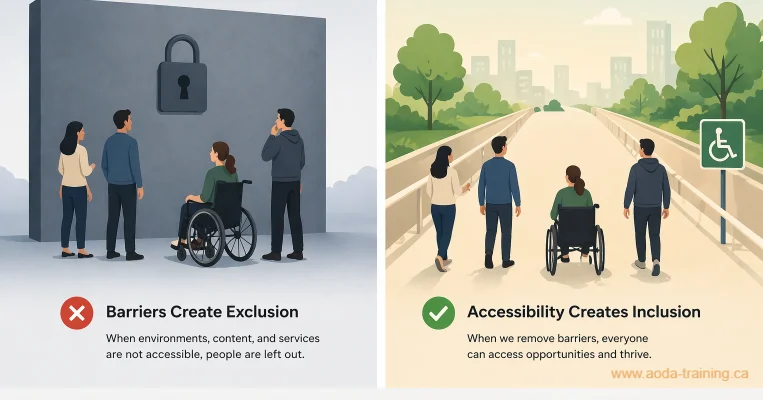
AODA deadlines are not future events. Most of them have already passed. If your organization has not trained its staff on the Customer Service Standard, you are currently out of compliance.
| Training type | Deadline status | Who it applies to |
|---|---|---|
| Customer Service Standard | Required since 2012 (private sector) — if not done, non-compliant now | All Ontario organizations with 1+ employee |
| IASR — Employment & Info/Communications | Required since 2014–2016 depending on org size | Organizations with 1+ employees (phased deadlines) |
| New employee training | As soon as reasonably practicable after hire | All organizations |
| Policy change training | Immediately when policy changes | All organizations |
| Compliance reporting | Every 3 years (next due depends on your last filing) | Organizations with 20+ employees |
The consequences of non-compliance are serious. Under AODA, the Ontario government can conduct audits, issue compliance orders, and impose fines:
$100,000/day
Maximum fine for non-compliant organizations
$50,000/day
Personal liability for directors and officers
- Fines up to $100,000 per day for organizations found non-compliant
- Fines up to $50,000 per day for individuals, including directors and officers
- Personal liability for directors and officers who fail to take reasonable steps to ensure compliance
- Government audit or inspection triggered by a complaint or random selection
Online AODA training: how to choose the right course
Most Ontario businesses use online training to meet their AODA obligations. It is practical, cost-effective, and — crucially — generates the completion records you need if the government ever audits your organization. Not all online training is equal, though. Here is what to look for before you commit to a platform or course.
What a compliant online course must include
- Coverage of the Customer Service Standard principles: dignity, independence, integration, equal opportunity
- Instruction on how to interact with customers who use assistive devices, support persons, or service animals
- Your organization's specific accessibility policies (some platforms allow you to add custom content)
- For IASR-covered organizations: content on the Integrated Accessibility Standards and Ontario Human Rights Code
- A completion certificate or trackable record for each staff member who finishes the course
Free vs paid AODA training
The Ontario government provides a free basic AODA training module through its AccessForward platform. For many small businesses, this covers the Customer Service Standard requirements adequately. Paid platforms tend to offer more:
For organizations with fewer than 10 employees and straightforward customer service operations, the free government module is a reasonable starting point. For businesses that are growing, have multiple locations, or need to demonstrate compliance through auditable records, a paid platform is the more defensible choice.
How long does AODA training certification last?
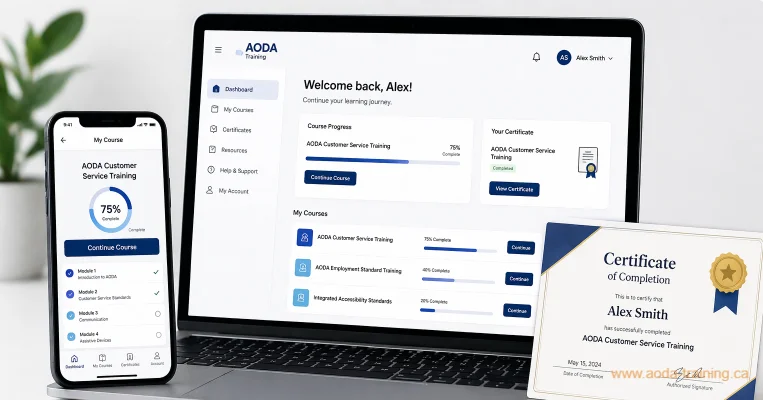
There is no fixed expiry period written into AODA legislation. The law does not say you must retrain every two years, for example. What it does say is that training must be provided when it first applies to your organization, and then again whenever policies or regulations change. In practice, that means:
- New employees must be trained when they start — there is no grace period
- All staff must be retrained when your organization's accessibility policies are updated
- Staff who move into roles with different accessibility responsibilities need training relevant to their new role
- When the Ontario government updates accessibility standards, training must reflect those updates
Best practice — and what most compliance advisors recommend — is to build AODA training into your annual staff development calendar. Review your training content each year, update it if policies have changed, and keep records of who completed refresher training and when.
AODA training for small businesses in Ontario
If you have fewer than 50 employees, your AODA obligations are lighter than those of larger organizations — but they are not negligible. The Customer Service Standard applies to every Ontario employer regardless of size. The main difference is in documentation and reporting requirements.
| Requirement | 1–19 employees | 20–49 employees | 50+ employees |
|---|---|---|---|
| Customer Service Standard training | Required | Required | Required |
| IASR training | Required | Required | Required |
| Written accessibility policy | Recommended | Recommended | Required (publicly available) |
| Multi-year accessibility plan | Not required | Not required | Required (posted publicly) |
| Training records | Recommended | Recommended | Required |
| Compliance report filing | Not required | Required every 3 years | Required every 3 years |
| Individual Accommodation Plans | Required if applicable | Required if applicable | Required |
The practical challenge for small businesses is not the training content — it’s the administration. Keeping track of who has trained, onboarding new staff promptly, and updating training when policies change takes process and discipline that many small teams do not have built in.
Role-specific AODA training
AODA training is not one course that everyone takes. Different roles carry different obligations, and effective training addresses those differences directly rather than giving everyone the same generic module.
Training for managers and HR teams
Managers need to understand their obligations under both AODA and the Ontario Human Rights Code. The overlap between the two is significant: the duty to accommodate under the Human Rights Code and the individual accommodation plan requirements under AODA cover much of the same ground, and getting either wrong creates liability.
Key areas for manager and HR training:
- How and when to offer an Individual Accommodation Plan (IAP)
- Conducting accessible recruitment — job postings, interviews, and selection processes
- Managing performance and absenteeism for employees with disabilities without discrimination
- Return-to-work processes following a disability-related absence
- When to involve legal or HR expertise, and what documentation to keep
Training for new employees
New employees should complete AODA training as part of onboarding, before or as soon as they begin interacting with customers or colleagues. For most roles, this means Customer Service Standard training in the first week.
For roles with additional obligations — HR, IT, marketing, content creation — layer on the relevant IASR modules once the baseline is done. The key is not to treat onboarding training as a one-off formality. AODA records should be part of every employee’s personnel file from day one.
Training for customer service and frontline staff
Frontline staff are the ones most likely to interact with a customer who has a disability. Their training needs to be practical, not just policy-based. Knowing the four principles is useful; knowing what to actually do when someone with a visual impairment approaches your counter is what matters.
Good customer service training includes scenarios: what do you do if a customer’s service animal is not permitted in your building by another policy? How do you communicate with a customer who is Deaf? What does ‘provide service in the same time and manner’ mean when someone uses a motorized wheelchair?
Training for content and digital teams
Developers, designers, content writers, and social media managers often get left out of AODA training plans — which is a problem, because they are the ones responsible for making your digital content accessible.
The Information and Communications Standard requires that new and significantly refreshed websites meet WCAG 2.0 Level AA. That means staff who create or commission digital content need to understand what that standard requires: alt text for images, proper heading structure, accessible colour contrast, captions for video, and keyboard-navigable interfaces.
AODA and website accessibility
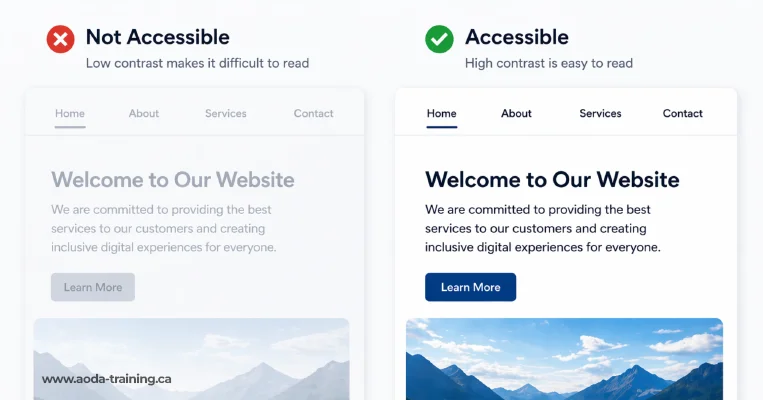
Website accessibility is one of the most commonly overlooked parts of AODA compliance, and one of the areas where enforcement has been tightening.
Under the Information and Communications Standard, organizations with 50 or more employees must ensure their public-facing websites and web content meet WCAG 2.0 Level AA. This deadline passed in January 2021 for most organizations. If your website does not currently meet this standard, you are out of compliance.
For smaller organizations (1 to 49 employees), the requirement applies to websites and web content created after January 1, 2014.
What WCAG 2.0 Level AA requires
WCAG stands for Web Content Accessibility Guidelines, published by the World Wide Web Consortium. Level AA is the middle tier — more demanding than Level A but more achievable than Level AAA. In practical terms, a WCAG 2.0 Level AA compliant website:
- › Has alt text on all meaningful images
- › Uses proper heading structure (H1, H2, H3) that reflects page hierarchy
- › Meets minimum colour contrast ratios (4.5:1 for normal text, 3:1 for large text)
- › Can be navigated entirely by keyboard, without a mouse
- › Has captions on all pre-recorded video content
- › Does not use content that flashes more than three times per second
- › Has form fields with descriptive labels and clear error messages
- › Uses descriptive link text — "Read the AODA compliance guide" rather than "Click here"
These are not just technical requirements. They represent the difference between a website that people with visual impairments, motor impairments, or cognitive disabilities can use and one that they cannot.
AODA compliance checklist for Ontario businesses
Use this as a health check for your organization. If any of these are not in place, you have a compliance gap.
Frequently asked questions
Is AODA training mandatory for all Ontario businesses?
What happens if my business does not complete AODA training?
How long does AODA training take to complete?
Does AODA certification expire?
Can I use the free Ontario government AODA training?
Do I need to keep records of AODA training?
What is the difference between AODA and the Ontario Human Rights Code?
Does AODA apply to websites?
What is an Individual Accommodation Plan?
Empower Your Team with Digital Accessibility
Ensure compliance, reduce legal risks, and build inclusive digital experiences.
Start AODA training for your team →Get your team AODA compliant
AODA compliance does not require a law degree or a dedicated accessibility team. It requires the right training, delivered to the right people, with records to show for it. That is what our courses are built for.
- Customer Service Standard training for all staff — compliant, practical, and trackable
- Role-specific options for managers, HR, IT, and content teams
- Custom policy content so your training reflects your organization's specific policies
- IASR modules covering Employment and Information & Communications standards
- Completion certificates and training records for every staff member
- Scales from a single employee to organization-wide rollout