
- What is AODA?
- AODA Training
What is AODA? Ontario's Accessibility Law Explained
AODA stands for the Accessibility for Ontarians with Disabilities Act — a provincial law passed in Ontario in 2005 that requires organizations to make their services, workplaces, and digital content accessible to people with disabilities.
Quantity Discounts
Price per course
6 to 20 courses
$20.95
21 to 50 courses
$17.95
51 to 200 courses
$13.95
201+ courses
Custom offer
If your business operates in Ontario and has at least one employee, AODA applies to you. That means training obligations, accessibility policies, and in many cases, requirements for your website.
This page explains what AODA is, why it exists, what it requires, and what the consequences of ignoring it look like.
Why AODA was created
Before AODA, there was no single law in Ontario that proactively required organizations to remove accessibility barriers. The Ontario Human Rights Code prohibited discrimination on the basis of disability, but it was reactive — it only addressed situations after a complaint was filed.
AODA changed that. Passed in 2005, it set a clear goal: make Ontario fully accessible to people with disabilities by 2025. Rather than waiting for complaints, organizations would be required to take concrete steps to prevent barriers from existing in the first place.
1.85M
Ontarians with a disability when AODA passed
2.6M
Ontarians with a disability today (1 in 5)
2005
Year AODA became Ontario law
Disabilities covered under AODA include:
- Physical disabilities — mobility impairments, chronic pain conditions
- Sensory disabilities — visual impairments, hearing loss, Deafness
- Cognitive and learning disabilities — dyslexia, ADHD, traumatic brain injury
- Mental health conditions — anxiety disorders, depression, PTSD
- Developmental disabilities — autism spectrum disorder, Down syndrome
- Age-related conditions — arthritis, dementia, vision and hearing changes
What does AODA require?
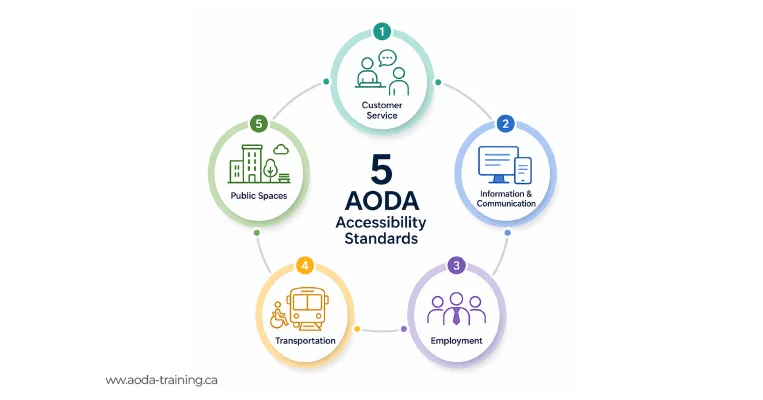
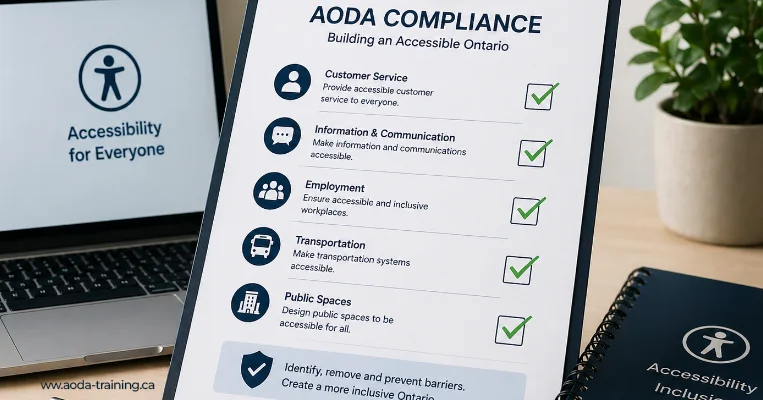
AODA works through a set of accessibility standards. Each standard covers a different area of public life and sets specific requirements for organizations to meet. There are five standards in total:
| Standard | What it covers | Applies to |
|---|---|---|
| Customer Service | How organizations serve customers and clients with disabilities | All organizations with 1+ employee |
| Employment | Accessible hiring, onboarding, accommodation, and workplace practices | All organizations with 1+ employee |
| Information & Communications | Accessible websites, documents, and digital content (WCAG 2.0 Level AA) | All organizations (phased by size) |
| Transportation | Accessible transit vehicles and services | Transit providers and operators |
| Design of Public Spaces | Accessible outdoor paths, rest areas, service counters, building entrances | Organizations developing or redeveloping public spaces |
The Customer Service Standard and the Employment Standard are bundled together with the Information & Communications, Transportation, and Design of Public Spaces standards under the Integrated Accessibility Standards Regulation (IASR). The IASR is the main regulation most Ontario businesses need to understand.
Who does AODA apply to?

AODA applies to every organization in Ontario that has at least one employee. That includes:
Private-sector businesses
Sole traders, SMEs, and large corporations — all sizes, all industries.
Non-profits & charities
Same obligations as private-sector businesses of equivalent size.
Designated public sector
Hospitals, universities, school boards, municipalities, Ontario government agencies.
Ontario government
The provincial government and its agencies face the strictest timelines.
There is no revenue threshold and no industry exemption. A two-person restaurant and a 10,000-person insurance company both have AODA obligations. The difference is the scope and complexity of what they are required to do.
| Organization size | Key additional obligations compared to smaller organizations |
|---|---|
| 1 employee+ | Customer Service training, basic employment accommodations |
| 20 employees+ | Must file an AODA compliance report every 3 years |
| 50 employees+ | Written accessibility policy, multi-year accessibility plan, training records, WCAG-compliant website (all publicly required) |
What AODA means for staff training
Training is one of the most concrete obligations under AODA — and the one most frequently missed by small businesses. Every person who works for or with your organization must be trained on the Customer Service Standard. This includes full-time and part-time employees, volunteers, contractors who interact with customers on your behalf, and anyone involved in developing your accessibility policies.
For organizations with 50 or more employees, the obligation goes further. The IASR requires training on the broader Integrated Accessibility Standards and on the Ontario Human Rights Code as it relates to disability.
When must training happen?
Training must be delivered before or as soon as reasonably practicable after a person starts in their role. It must also be updated and re-delivered whenever your accessibility policies change. There is no grace period for new hires — AODA training should be part of onboarding, not something that happens six months after someone starts.
What happens if training is not completed?
The Ontario government audits organizations for AODA compliance. If your organization is found to have untrained staff, you may receive a compliance order. Ongoing non-compliance after a compliance order can result in fines:
$100,000/day
Maximum fine for non-compliant organizations
$50,000/day
Personal liability for directors and officers
AODA vs the Ontario Human Rights Code
AODA and the Ontario Human Rights Code both relate to disability, but they work differently.
| AODA | Ontario Human Rights Code | |
|---|---|---|
| Purpose | Proactively requires organizations to remove and prevent barriers | Prohibits discrimination after it occurs |
| How it works | Sets specific standards and timelines all organizations must meet | Applies when a person files a complaint of discrimination |
| Enforcement | Government audits, compliance orders, and fines | Human Rights Tribunal of Ontario |
| Overlap | Employment Standard mirrors many Code obligations around accommodation | Both cover disability-related accommodation in the workplace |
In the employment context, the two overlap significantly. If an employer fails to provide an accessible workplace under AODA, that same failure may also be a violation of the Human Rights Code. AODA training for managers covers both pieces of legislation.
Online AODA training: how to choose the right course

Yes. Under the Information and Communications Standard, organizations must make their websites and web content accessible to people with disabilities. The standard requires compliance with WCAG 2.0 Level AA — the internationally recognized benchmark for web accessibility.
The deadlines have already passed for most organizations:
- Organizations with 50+ employees: all public-facing websites must meet WCAG 2.0 Level AA (deadline: January 2021)
- Organizations with 1–49 employees: web content created after January 1, 2014 must meet WCAG 2.0 Level AA
Frequently asked questions
What does AODA stand for?
- AODA stands for the Accessibility for Ontarians with Disabilities Act. It is a provincial law in Ontario, Canada, passed in 2005.
Is AODA a federal or provincial law?
- AODA is a provincial law. It applies only within Ontario. The equivalent federal legislation is the Accessible Canada Act (ACA), which covers federally regulated organizations such as banks, broadcasters, and telecommunications companies.
What is the goal of AODA?
- The stated goal of AODA is to make Ontario fully accessible to people with disabilities by 2025. This means identifying and removing barriers in customer service, employment, information and communications, transportation, and the design of public spaces.
Does AODA apply to non-profits?
- Yes. AODA applies to all organizations in Ontario with at least one employee, including non-profits, charities, associations, and community organizations. The obligations are the same as for private-sector businesses of the same size.
What is the IASR?
- The Integrated Accessibility Standards Regulation (IASR) is the regulation that bundles four of the five AODA standards — Employment, Information and Communications, Transportation, and Design of Public Spaces — into a single regulation. Most Ontario businesses need to comply with the IASR as well as the Customer Service Standard.
Next steps for your business
If you are reading this because you are not sure whether your organization is compliant with AODA, the most common gap is training. Start with the Customer Service Standard — every employee needs it.
- › Read the full AODA Training Guide to understand all your obligations
- › Identify which staff need Customer Service training vs IASR training
- › Check whether your website meets WCAG 2.0 Level AA
- › Review your accessibility policy — or create one if you don't have it
- › File your compliance report if your organization has 20 or more employees
Empower Your Team with Digital Accessibility
Ensure compliance, reduce legal risks, and build inclusive digital experiences.
Start AODA training for your team →Get your team AODA compliant
The right training, delivered to the right people, with records to show for it. Our courses cover the Customer Service Standard, the IASR, and role-specific obligations in one platform.
- Customer Service Standard training for all staff
- Role-specific options for managers, HR, IT, and content teams
- IASR modules with Ontario Human Rights Code content
- Completion certificates and audit-ready records