
- Who Needs AODA Training in Ontario
- AODA Training
Who Needs AODA Training in Ontario? A Complete Breakdown
Almost everyone connected to your Ontario organization. AODA training is not just for customer-facing staff or large corporations — it applies to every person who works for, volunteers with, or delivers services on behalf of any organization with at least one employee.
Quantity Discounts
Price per course
6 to 20 courses
$20.95
21 to 50 courses
$17.95
51 to 200 courses
$13.95
201+ courses
Custom offer
AODA training is not just for customer-facing staff or large corporations. It applies to every person who works for, volunteers with, or delivers services on behalf of any organization operating in Ontario with at least one employee.
Where businesses get caught out is in the details. It is not enough to train some staff. The law requires that all employees, volunteers, and third-party contractors who interact with members of the public complete training — and that new staff are trained as soon as they start.
Who AODA training applies to
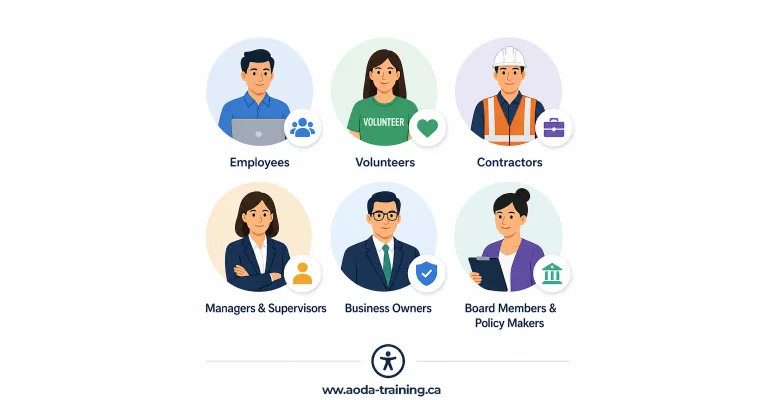
Under the Customer Service Standard — which applies to every Ontario organization with at least one employee — training is mandatory for:
All employees
Full-time, part-time, seasonal, casual, and fixed-term — without exception.
Volunteers
Those who interact with the public or participate in developing organizational policies.
Third-party contractors
Service providers who deliver services on your behalf — reception, delivery, IT support, cleaning.
Policy developers
Anyone involved in developing, implementing, or enforcing your organization's accessibility policies.
Many small businesses assume AODA training only applies once they reach a certain headcount. This is not correct. The Customer Service Standard training obligation applies from the moment you have a single employee. Size only affects the scope of your documentation and reporting obligations — not whether training is required.
AODA training by role: what each person needs
The type and depth of training required depends on what a person does. Here is a role-by-role breakdown.
| Role | Training required | Key topics covered |
|---|---|---|
| All employees (all org sizes) | Customer Service Standard (mandatory baseline) | 4 principles, assistive devices, support persons, your accessibility policies |
| Managers & supervisors | Customer Service + Employment Standard | Individual accommodation plans (IAPs), accessible recruitment, return-to-work |
| HR professionals | Customer Service + Employment Standard | Duty to accommodate, AODA and Human Rights Code overlap, documentation |
| Content writers, marketers, comms | Customer Service + Information & Communications | WCAG 2.0 Level AA, accessible content, alt text, captions |
| IT, web developers, designers | Customer Service + Information & Communications | WCAG 2.0 Level AA technical requirements, accessible HTML, keyboard nav |
| Customer service & frontline | Customer Service Standard (scenario-focused) | Practical interaction skills, TTY, service animals, accessible formats |
| Volunteers | Customer Service Standard | Same as employees; must be completed before or as soon as they begin |
| Third-party contractors | Customer Service Standard (if serving the public on your behalf) | Your organization is responsible for ensuring their training |
Training obligations by organization size

The baseline training requirement is the same regardless of how many people you employ. What changes as your organization grows is the additional layer of obligations around documentation, reporting, and the scope of training.
Organizations with 1 to 49 employees
- Customer Service Standard training: required for all staff
- IASR training: required, but no obligation to keep formal training records
- Written accessibility policy: not required to be publicly filed, but strongly recommended
- Compliance reporting: required every 3 years if you have 20 or more employees
Organizations with 50 or more employees
- Customer Service Standard and IASR training: required for all staff
- Training records: you must keep records of who has been trained and when
- Written accessibility policy: required and must be publicly available
- Multi-year accessibility plan: required and must be posted publicly
- Individual Accommodation Plans: must have a documented process for creating them
- Compliance report: filed with the Ontario government every 3 years
When does AODA training need to happen?
Timing matters as much as content. Here is when each training obligation is triggered.
| Trigger | When training must be delivered |
|---|---|
| Existing employees | Already required. If not yet completed, you are currently non-compliant. |
| New employee hired | Before they begin, or as soon as reasonably practicable after starting. No formal grace period exists in the legislation. |
| Volunteer starts | Same as new employees. Must be trained before or shortly after they begin. |
| Contractor engaged | Before they begin delivering services on your behalf. |
| Accessibility policy changes | Training must be updated to reflect the change and re-delivered to all affected staff. |
| Staff member changes roles | If their new role has different accessibility responsibilities, role-specific training must be updated. |
| AODA regulations updated | Training must be updated to reflect regulatory changes. |
What happens if staff are not trained?
Non-compliance with AODA training requirements exposes your organization to government enforcement. The Ontario government audits organizations, investigates complaints, and issues compliance orders.
$100,000/day
Maximum fine for non-compliant organizations
$50,000/day
Personal liability for directors and officers
Beyond the financial risk, a customer who has a negative experience because your staff were not trained on accessible customer service can file a complaint with the Accessibility Directorate of Ontario. If your training records cannot demonstrate compliance, you are in a much weaker position.
Training compliance checklist: have you covered everyone?
Frequently asked questions
Does AODA training apply to part-time employees?
- Yes. AODA training applies to all employees regardless of the number of hours they work. Part-time, casual, seasonal, and fixed-term employees all need to complete Customer Service Standard training. There is no hours threshold below which the requirement does not apply.
Do volunteers need AODA training?
- Yes, if they interact with members of the public or are involved in developing your accessibility policies. This covers most volunteers in customer-facing non-profits, charities, community organizations, and events.
Who is responsible for training third-party contractors?
- Your organization is. If you engage a contractor to deliver services to your customers on your behalf, you are responsible for ensuring that person or company has completed AODA Customer Service Standard training. This means checking training status when you engage contractors and documenting it.
Does a one-person business need AODA training?
- If you have at least one employee, yes. A sole trader who works alone with no staff has no training obligation. The moment you hire your first employee — even one part-time staff member — AODA training becomes mandatory for that person.
What training do managers need beyond the basics?
- Managers need Customer Service Standard training as a baseline, plus Employment Standard training covering individual accommodation plans, accessible recruitment, return-to-work processes, and performance management for employees with disabilities.
- AODA Training for Managers: Full Requirements
Does AODA training need to be repeated?
- There is no fixed renewal period. However, training must be re-delivered whenever your organization’s accessibility policies change, and staff who move into roles with different accessibility responsibilities need updated training. Annual review is best practice.
Empower Your Team with Digital Accessibility
Ensure compliance, reduce legal risks, and build inclusive digital experiences.
Start AODA training for your team →Make sure everyone is covered
Our online AODA training platform makes it straightforward to cover all staff, track who has completed what, and generate the records you need if you are ever audited.
- Customer Service Standard module for all staff, volunteers, and contractors
- Manager-specific module — accommodation plans, accessible recruitment
- IASR module for managers, HR, IT, and content teams
- Completion certificates and audit-ready records for every person