
- AODA Training Deadlines & Fines
- AODA Training
AODA Training Deadlines & Fines: Enforcement Guide for 2026
Every AODA compliance deadline for Ontario businesses has passed. Learn what fines apply, how enforcement works, and what to do if your organization is currently non-compliant.
Quantity Discounts
Price per course
6 to 20 courses
$20.95
21 to 50 courses
$17.95
51 to 200 courses
$13.95
201+ courses
Custom offer
AODA Fines: What the Law Allows
Section 37 of the AODA sets out the maximum penalties for non-compliance. These are the legislated ceilings — actual penalties issued in practice depend on the severity of the contravention, the organization’s history, and its response to enforcement.
AODA Compliance Requirements: Current Status in 2026
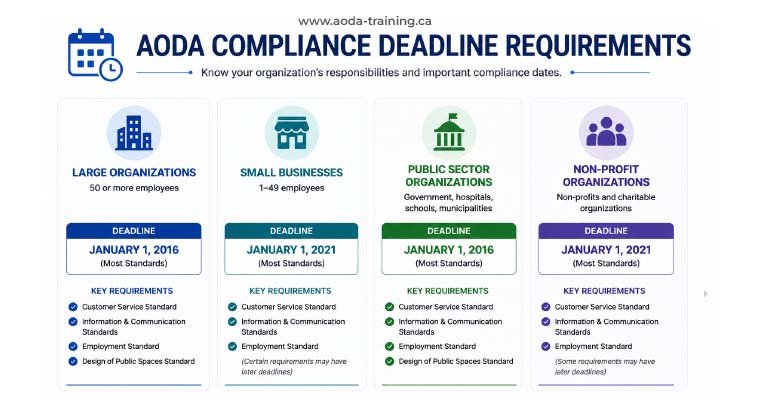
The requirements below are active, enforceable law. There are no future start dates to wait for — every obligation listed is in force now. The only upcoming deadline is the AODA compliance report, due December 31, 2026.
| Requirement | Organization size | Current status in 2026 |
|---|---|---|
| Customer Service Standard: train all staff on accessible service, the four principles, and your accessibility policies | 1+ employees | Required now — every current employee, volunteer, and contractor must be trained. New hires must be trained on or before their start date. |
| Customer Service Standard: written process for receiving and responding to accessibility feedback from customers | 1+ employees | Required now — a contact email or phone number with a commitment to respond satisfies this requirement. |
| Customer Service Standard: notify customers when an accessible service or facility is temporarily disrupted | 1+ employees | Required now — applies whenever a ramp, TTY, accessible entrance, or other accessible facility is unavailable. |
| IASR: train all staff on IASR requirements for their role and on the Ontario Human Rights Code as it relates to disability | 1+ employees | Required now — must be delivered to current staff and to every new hire as soon as practicable after starting. |
| IASR Employment Standard: accessible recruitment — include accommodation statements in job postings and interview invitations | 1+ employees | Required now — applies to every job posting and every interview invitation your organization issues. |
| IASR Employment Standard: provide accessible formats of employment information on request | 1+ employees | Required now — offer letters, training materials, performance reviews, and emergency procedures must be available in accessible formats. |
| IASR Employment Standard: documented Individual Accommodation Plan (IAP) process | 50+ employees | Required now — the process must exist and be ready to use whenever an employee with a disability requests accommodation. |
| IASR Employment Standard: documented return-to-work process | 50+ employees | Required now — must be in place for employees returning from disability-related absence. |
| IASR Information & Communications: WCAG 2.0 Level AA for websites and new web content | 1–49 employees | Required now — applies to all web content published since January 2014. Every page published since then must comply. |
| IASR Information & Communications: WCAG 2.0 Level AA for all public-facing web content | 50+ employees | Required now — applies to all public-facing content. No exemptions for older pages. |
| IASR Information & Communications: provide accessible formats and communication supports on request, at no extra cost | 1+ employees | Required now — applies to all information and communications your organization produces, digital and print. |
| Written accessibility policy, documented and publicly available | 50+ employees | Required now — must be posted publicly (website or on request) and reviewed regularly. |
| Multi-year accessibility plan, documented and publicly posted | 50+ employees | Required now — must be publicly accessible and updated at least every five years. |
| Training records for all staff | 50+ employees | Required now — records must show who was trained, on what, and when. Must be available for government audit. |
| AODA accessibility compliance report — filed every 3 years through ontario.ca portal | 20+ employees (businesses & non-profits) | UPCOMING DEADLINE: December 31, 2026 — businesses & non-profits with 20+ employees. Public sector deadline was December 31, 2025. |
How AODA Enforcement Works
AODA enforcement is administered by the Accessibility Directorate of Ontario, a branch of the Ministry for Seniors and Accessibility. Enforcement is triggered in two ways: scheduled compliance reviews and complaint-driven investigations.
Scheduled Compliance Reviews
The Ontario government conducts periodic compliance reviews of organizations based on sector, size, and filing history. During a compliance review, the Directorate requests documentation: accessibility policies, training records, compliance report filings, and evidence of accessible service practices. Organizations selected for review receive written notice and a specified timeframe to provide documentation.
Complaint-Driven Investigations
Any individual can file a complaint with the Accessibility Directorate about an organization’s AODA compliance. Complaints trigger an investigation. The organization is notified, given an opportunity to respond, and required to demonstrate compliance or a remediation plan. Complaints are more likely to trigger enforcement action for smaller violations than scheduled reviews, because the Directorate must respond to every complaint it receives.
The Compliance Order Process
If an investigation or review finds non-compliance, the Directorate issues a compliance order specifying the specific requirements not met, the steps required to reach compliance, and a deadline by which compliance must be achieved.
The Role of the Human Rights Tribunal
AODA enforcement and Ontario Human Rights Code enforcement are separate systems. A person with a disability who is denied accessible service may file both an AODA complaint with the Accessibility Directorate and a Human Rights complaint with the Human Rights Tribunal of Ontario (HRTO). AODA fines and Human Rights Tribunal remedies can run concurrently.
What Typically Triggers an AODA Complaint
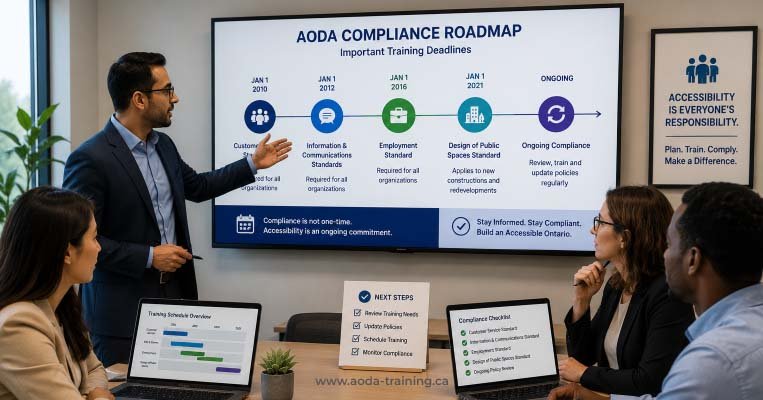
Understanding the patterns that generate complaints helps organizations prioritize their compliance efforts toward the areas of highest exposure.
| Common complaint trigger | Why it generates complaints | Primary standard involved |
|---|---|---|
| Website that cannot be navigated by keyboard or screen reader | Blind users and users with motor impairments are completely blocked from completing key tasks. These users are aware of their rights and know how to file complaints. | IASR — Information & Communications Standard (WCAG 2.0 Level AA) |
| Customer refused access because of a service animal | Service animal users frequently encounter this problem and are highly likely to report it. | Customer Service Standard |
| Accessible format of a document refused or delayed | A customer who requests a document in large print or electronic format and is refused or ignored has a clear, documentable denial of a specific right. | IASR — Information & Communications Standard |
| Staff treating a customer with a disability with disrespect or making assumptions about capability | Dignity violations are the most emotionally impactful accessibility failures and are highly likely to generate both AODA complaints and Human Rights applications. | Customer Service Standard (dignity principle) |
| Accommodation request in employment refused or ignored | Employment Standard violations often come to light during or after the employment relationship through Human Rights applications, which are frequently cross-filed with AODA complaints. | IASR — Employment Standard |
| Compliance report filed when organization is not actually compliant | A false compliance report is itself a violation. A complaint that reveals the gap between a filed report and actual practice is particularly serious for the organization. | AODA Act s.14 (compliance report filing obligations) |
What to Do If Your Organization Is Currently Non-Compliant
Non-compliance is the starting point for most Ontario organizations, not the exception. The question is not whether to become compliant — it is how to prioritize remediation given your current gaps, your organization’s size, and your risk exposure.
Why Demonstrating Good Faith Matters in Enforcement
AODA enforcement is not primarily punitive — its stated purpose is to achieve compliance, not to collect fines. The Accessibility Directorate has consistently taken a graduated approach: compliance orders before fines, and warnings before compliance orders, in most cases.
| Response to enforcement | Likely outcome |
|---|---|
| Organization acknowledges the gap, provides a remediation plan, and meets compliance order deadlines | Compliance order closed. Fine risk is minimal if deadlines are met. Positive finding in any subsequent complaint investigations. |
| Organization contests the compliance order without substantive compliance progress | Escalation to fines. Per-day accrual begins at the order deadline. Director and officer personal liability engaged. |
| Organization has documented its compliance programme (training records, policy history, audit evidence) even if not fully compliant at time of review | Demonstrates good faith. Compliance orders typically allow more time for remediation. Complaint investigations are more likely to be resolved through negotiation. |
| Organization has no documentation, no training records, no policy, and takes no action following initial contact | Highest risk profile. No evidence of good faith. Fastest escalation to formal enforcement action. |
AODA Compliance Report: What It Is and What Happens If You Don't File
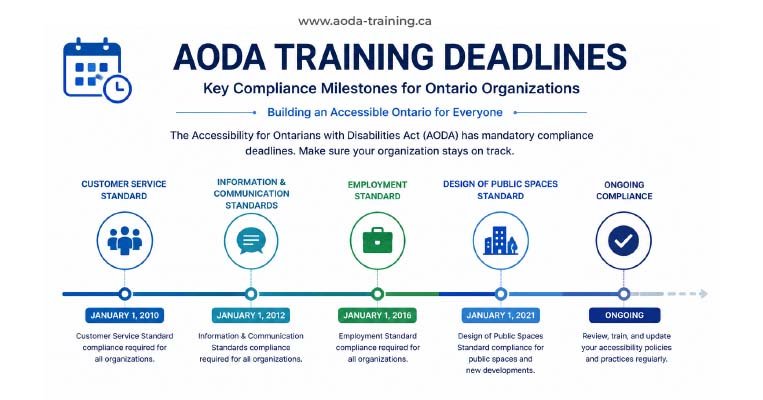
Organizations with 20 or more employees are required to file an AODA compliance report with the Ontario government every three years. The report is a declaration — not an audit — that your organization meets the applicable accessibility requirements.
What the Compliance Report Covers
- Confirmation that accessibility policies are in place (50+ employees)
- Confirmation that staff have been trained on AODA requirements
- Confirmation that websites meet applicable WCAG standards
- Confirmation that accessible formats are provided on request
- Confirmation that employment accessibility practices are in place (50+ employees)
What Happens If You Don't File
Failure to file a compliance report is itself a violation of the AODA and is subject to the same maximum penalties as other violations. The government’s compliance filing database is one of the primary tools used to identify organizations for scheduled compliance reviews. Organizations that have not filed, or have filed late, are more likely to be selected for a review.
Filing a False Report
The compliance report is a legal declaration. Filing it before your organization has actually met the requirements creates personal liability for the individuals who signed the declaration — in addition to organizational liability for the underlying non-compliance.
Frequently asked questions
Has anyone actually been fined under AODA?
- The Ontario government does not routinely publish individual fine decisions. Publicly confirmed enforcement actions have included compliance orders issued to municipal governments and large private-sector organizations. While maximum fines of $100,000 per day are rarely applied in practice, compliance orders are regularly issued and the escalation path to fines is established in law. The more significant risk for most organizations is reputational and legal exposure from complaints, not maximum statutory fines.
Can my organization be fined for AODA violations it is already remedying?
- Active, documented remediation is the most important factor in enforcement outcomes. An organization that receives a compliance order, provides a credible remediation plan, and meets the order’s deadline is unlikely to face fines. An organization that receives an order and takes no action will face fines beginning from the day the order’s deadline passes. Document every remediation step — dates, changes made, training delivered, policies updated.
Does AODA apply if my business has no physical location?
- Yes. AODA applies to all Ontario employers with at least one employee, regardless of whether they have a physical location. Remote businesses, online-only companies, and home-based businesses with employees all have AODA training and digital accessibility obligations. The website accessibility requirement under the Information and Communications Standard applies specifically to digital content, which is the primary channel for organizations without a physical presence.
What is the statute of limitations for AODA violations?
- There is no statute of limitations in the conventional sense for ongoing AODA violations. Non-compliance that has not been remediated is an ongoing contravention. The per-day fine structure reflects this — each day of continued non-compliance is a new offence. Historical non-compliance that has since been remediated is less likely to trigger enforcement than current non-compliance, but organizations should not assume that remediation eliminates historical liability entirely.
If I train my staff now, does that undo past non-compliance?
- Training your staff now addresses the ongoing compliance gap going forward. It does not eliminate the historical period of non-compliance. However, prompt action significantly reduces enforcement risk: an organization that trains its staff and can demonstrate current compliance is a much lower enforcement priority than one that remains non-compliant. The practical advice is to act now and document everything — the compliance posture you establish today is your primary protection.
How does the Ontario Human Rights Code interact with AODA fines?
- They are separate enforcement systems with separate remedies. AODA fines are administrative penalties imposed by the Accessibility Directorate. Human Rights Code applications are filed with the Human Rights Tribunal of Ontario and can result in monetary compensation to the affected individual, public interest remedies, and reputational exposure. An accessibility failure can trigger both simultaneously. The Human Rights route is often faster and more financially impactful for complainants than the AODA enforcement route.
Empower Your Team with Digital Accessibility
Ensure compliance, reduce legal risks, and build inclusive digital experiences.
Start AODA training for your team →Close Your Compliance Gap — Start with Training
The single fastest compliance action any Ontario organization can take is training all staff on the Customer Service Standard and IASR. Our online platform delivers compliant training, generates completion certificates, and creates the training records your organization needs to demonstrate good faith in any enforcement context.
- Customer Service Standard: the four principles, disability interaction, assistive devices, service animals
- Role-specific modules for managers, HR, and digital teams
- Training records exportable for audit and compliance report purposes
- IASR training: Employment Standard, Information & Communications Standard, Ontario Human Rights Code
- Completion certificate for every staff member, dated and downloadable
- Updated when Ontario accessibility standards change