
- ADA vs AODA vs WCAG
- Website Accessibility
ADA vs AODA vs WCAG: Key Differences Explained
Confused by ADA, AODA, and WCAG? Learn the difference between US and Ontario accessibility law and the international technical standard they both reference — and which ones apply to your organization.
Quantity Discounts
Price per course
6 to 20 courses
$20.95
21 to 50 courses
$17.95
51 to 200 courses
$13.95
201+ courses
Custom offer
The Short Answer: What Each One Is
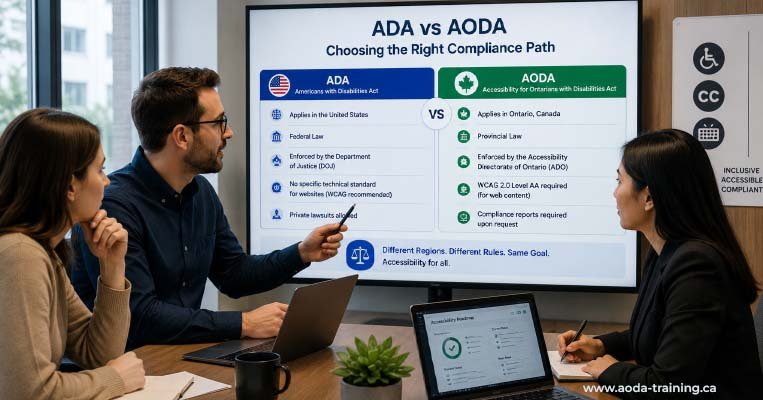
Three acronyms come up repeatedly in web accessibility conversations: WCAG, AODA, and ADA. People use them interchangeably, but they are different things at different levels. WCAG is a technical standard. AODA is Ontario’s provincial law. ADA is US federal law. Understanding the difference matters because each imposes different obligations, applies to different organizations, and is enforced by different bodies.
| Acronym | Full name | Type | Jurisdiction |
|---|---|---|---|
| WCAG | Web Content Accessibility Guidelines | Technical standard (not a law) | International — published by W3C, used globally |
| AODA | Accessibility for Ontarians with Disabilities Act | Provincial law | Ontario, Canada only |
| ADA | Americans with Disabilities Act | Federal law | United States only |
| ACA | Accessible Canada Act | Federal law | Canada (federally regulated organizations only) |
AODA: Ontario's Accessibility Law
AODA is broader than website accessibility. It covers five standards: Customer Service, Employment, Information & Communications (which includes websites), Transportation, and Design of Public Spaces. Website accessibility under AODA is one component of a larger compliance framework that includes staff training, accessible policies, and employment practices.
- Applies to all Ontario employers with 1+ employee
- Website obligation: WCAG 2.0 Level AA for content created since January 2014 (1–49 employees) or all public-facing content (50+ employees)
- Compliance reporting: every 3 years for organizations with 20+ employees
- Personal liability: directors and officers face fines of up to $50,000/day
ADA: US Federal Accessibility Law
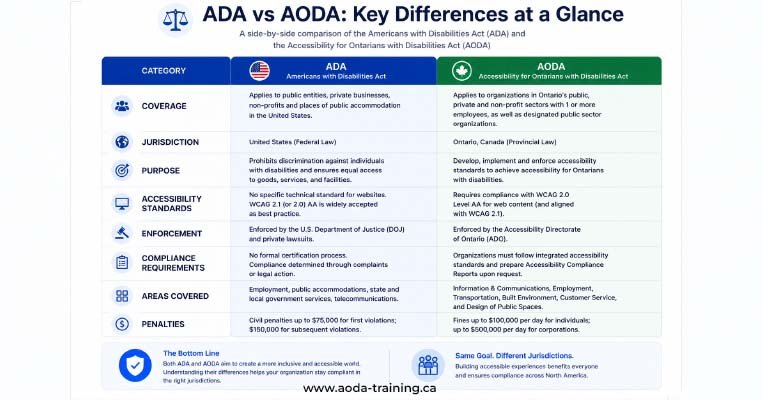
The ADA does not explicitly mention websites — it was written in 1990 before the web existed. However, the Department of Justice and federal courts have consistently interpreted Title III to cover websites as places of public accommodation. In 2022, the DOJ issued guidance confirming that web accessibility is required under the ADA and that WCAG 2.0 Level AA is the appropriate technical standard.
- Applies to US-based businesses and organizations operating in the US
- Canadian organizations: only applies if you actively operate in or market to the US market
- Enforcement: primarily through private lawsuits — thousands of ADA web accessibility lawsuits filed annually in the US
- Risk: high-volume litigation particularly targets e-commerce, hospitality, and healthcare websites
Accessible Canada Act: Federal Canadian Law
For most Ontario businesses, the ACA is not directly relevant because they are provincially regulated and subject to AODA. The ACA matters if your organization is a federally regulated entity — a bank, airline, telecoms company, or federal Crown corporation.
- Does not replace AODA — both apply to federally regulated entities with Ontario operations
- Administered separately by Accessibility Standards Canada and the Canadian Human Rights Commission
- Most Ontario businesses do not need to consider the ACA — it applies to federal sectors only
Which Laws Apply to Your Organization?
The matrix below shows which frameworks apply in which situations. Most Ontario businesses only need to focus on AODA.
| Organization type | AODA | ADA | ACA |
|---|---|---|---|
| Ontario private sector business (provincially regulated) | Yes — mandatory | No (unless US operations) | No |
| Ontario non-profit organization | Yes — mandatory | No | No |
| Ontario municipal government | Yes — mandatory (stricter rules) | No | No |
| Federally regulated Canadian entity (bank, airline, telecoms) | Yes (Ontario employees/services) | No (unless US operations) | Yes — mandatory |
| US business operating in Ontario | Yes — if Ontario employees or customers | Yes — for US operations | No (unless federally regulated) |
| US business with no Canadian presence | No | Yes — mandatory | No |
| Multinational with operations in both countries | Yes — Ontario operations | Yes — US operations | If federally regulated in Canada |
The Critical Differences in Enforcement
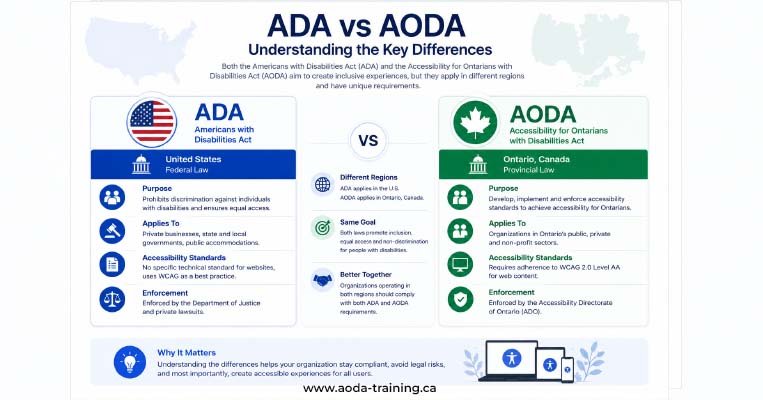
AODA and ADA have fundamentally different enforcement mechanisms. Understanding this shapes how organizations should think about their risk exposure.
Frequently asked questions
Does AODA apply to US companies with Canadian customers?
- Yes, if the US company has employees in Ontario or provides goods and services to Ontario residents through a presence in Ontario. A US company that employs Ontario-based remote workers or has Ontario operations has AODA obligations for those employees and the customers they serve. A US company that simply sells online to Canadians without any Ontario-based employees or operations is in more ambiguous territory.
If we are AODA compliant, are we also ADA compliant?
- Likely yes for web accessibility, with some caveats. Both AODA and ADA reference WCAG 2.0 Level AA as the web accessibility standard. If your website meets WCAG 2.0 Level AA, it satisfies the web accessibility component of both laws. However, ADA Title III has additional requirements beyond website accessibility (physical accessibility of premises) and AODA has additional requirements (training, employment practices, policies). Meeting one law’s web standard satisfies the other’s web standard; meeting one law entirely does not satisfy the entire other law.
Does the ADA apply to Canadian websites?
- The ADA applies based on whether an organization is subject to US jurisdiction — which generally means operating in the US, employing US workers, or offering goods and services to US customers through a US presence. A purely Canadian company with no US employees, no US physical presence, and no targeted US marketing is unlikely to be subject to ADA jurisdiction, though this area of law continues to evolve. Canadian companies that actively market to US customers through a US-domain website or US operations are more exposed.
What is the Accessible Canada Act and does it replace AODA?
- The Accessible Canada Act (2019) is federal Canadian legislation that applies to federally regulated industries: banks, airlines, telecoms companies, broadcasters, and federal Crown corporations. It does not replace AODA. AODA continues to apply to all Ontario organizations, including federally regulated ones for their Ontario operations. Organizations in federally regulated sectors have obligations under both. The ACA is administered by Accessibility Standards Canada and the Canadian Human Rights Commission, separately from AODA’s Accessibility Directorate.
Is WCAG compliance sufficient for both AODA and ADA?
- For website accessibility specifically, yes — meeting WCAG 2.0 Level AA satisfies the web accessibility component of both AODA and ADA. But both laws have requirements beyond website accessibility. AODA requires staff training, accessible policies, employment practices, and accessible formats on request. ADA Title III requires accessible places of public accommodation and accessible goods and services more broadly. Website WCAG compliance is a necessary but not sufficient condition for full compliance with either law.
Empower Your Team with Digital Accessibility
Ensure compliance, reduce legal risks, and build inclusive digital experiences.
Start AODA training for your team →Get Your Website Compliant with Both AODA and ADA
If your organization operates in Ontario and the United States, a single website audit against WCAG 2.1 Level AA satisfies the web accessibility component of both AODA and ADA — and positions you for Ontario’s anticipated standard update.
- Automated scanning with axe and WAVE
- WCAG 2.1 coverage for organizations targeting both US and Canadian markets
- Prioritized report your development team can act on directly
- Manual WCAG 2.0 Level AA testing — satisfies both AODA and ADA
- Screen reader testing with NVDA and VoiceOver
- Optional compliance statement covering both AODA and ADA context